
The Positional Revolution: How India’s Decimal System and the Journey of Zero Changed Global Mathematics
From ancient counting methods to the numbers used in every classroom, bank, laboratory and computer today: the remarkable journey of a mathematical idea across civilisations.
Introduction: A small set of symbols, an extraordinary change
Imagine trying to write down a number such as 8,764,321 using only Roman numerals. Now imagine multiplying it by another large number, dividing the result, and recording the answer accurately.
It is possible to perform arithmetic without the modern decimal system. Civilisations did so for thousands of years. But representing numbers and calculating with them were not equally easy in every system.
The notation we use today has a remarkable advantage: it represents enormous numbers using just ten symbols — 0 to 9. More importantly, the position of each symbol determines its value.
That principle is called positional notation. Combined with a decimal base and a working concept of zero, it transformed written calculation.
The system we now commonly call Hindu-Arabic numerals developed in India, travelled through scholarly and commercial networks into the Arabic-speaking world, and gradually became established in Europe and beyond. This was not the achievement of one mathematician or one moment. It was a long intellectual journey involving several civilisations.
1. Before the modern digits: How did people represent numbers?
People needed numbers long before they had written numeral systems. They counted animals, measured land, recorded harvests, tracked trade and calculated astronomical cycles. Different societies developed different ways of representing quantities.
Tally marks: counting before written mathematics
One of the simplest methods was to make a mark for each item counted. Groups of marks could represent quantities, while objects such as stones, tokens or sticks helped people keep track. Tally systems were easy to understand, but large quantities became cumbersome to record and manipulate.
Egyptian numerals: symbols for powers of ten
Ancient Egyptian notation used different symbols for units, tens, hundreds, thousands and larger powers of ten. Quantities were represented by repeating and combining these symbols. This was an effective system for administration, construction and record-keeping, but it was not a positional system like the one used today.
Babylonian mathematics: a sophisticated base-60 system
The Babylonians developed a sexagesimal, or base-60, system. Its influence survives in our measurement of time and angles: 60 seconds in a minute, 60 minutes in an hour and 360 degrees in a circle. Babylonian notation used positional principles, but its base was 60 rather than 10. Its history also includes the use of a placeholder sign to help distinguish empty positions.
Greek and Roman numerals
Greek numeral traditions often used letters to represent numbers. Roman numerals used combinations of symbols such as I, V, X, L, C, D and M. These systems were useful for inscriptions, records and everyday representation. However, their notation did not provide the same compact place-value structure as the modern decimal system. Roman calculations were not impossible: people used counting boards, counters and abaci. The important difference was that written arithmetic was less straightforward.
The Mayan system: another path to positional notation
The Maya developed a sophisticated vigesimal, or base-20, numerical system and used a zero symbol. This is an important reminder that mathematical innovation did not happen in only one part of the world. Different civilisations developed powerful numerical ideas in their own historical settings.
The central question, then, is not whether earlier societies could calculate. They certainly could. It is how a system using a small number of symbols made written calculation more flexible, compact and scalable.
2. The Indian contribution: place value and the power of zero
The defining feature of the decimal system is that a digit's value depends on its position.
The same digit appears four times in 5,555, but it represents four different quantities. This is the power of place value. In a positional decimal system, each position represents a power of ten: 5,555 = 5(1000) + 5(100) + 5(10) + 5(1). Only ten symbols are needed to represent numbers of extraordinary size.
From Brahmi numerals to the familiar digits
The modern forms of our digits did not appear fully formed. Their history involves earlier Indian numeral traditions, including Brahmi numerals, and the gradual development and transmission of later forms. It is important to distinguish between the evolution of the shapes of the digits and the development of the complete decimal place-value system. These were related developments, but they were not necessarily simultaneous. The evidence for the system comes from inscriptions, manuscripts and mathematical texts, and historians continue to examine how the notation developed over time.

Why zero changed everything
Zero has two closely related but distinct functions. First, it is a placeholder. In the number 204, it tells us that there are no tens. Without it, the positions of the other digits would be ambiguous. Second, zero is a number in its own right. It represents a quantity of none and can participate in arithmetic.
The Sanskrit word śūnya is associated with emptiness or void. The Arabic word ṣifr, through later transmission into European languages, contributed to the words zero and cipher. Indian mathematical traditions gave zero a particularly important role in the decimal place-value system.
Brahmagupta and the rules of zero
In 628 CE, the Indian mathematician Brahmagupta wrote the Brāhmasphuṭasiddhānta. It contains systematic rules for arithmetic involving zero and positive and negative quantities. His work was a major milestone in the history of mathematical thought. Some of his rules do not match the modern treatment of division by zero, but his contribution helped establish zero as an object of mathematical reasoning rather than merely an empty space.
This distinction is fundamental: a placeholder helps organise a written number, while zero as a number can be studied and used in mathematical operations.
3. Why did this mathematical development matter in ancient India?
India had a long tradition of mathematical and astronomical scholarship. Astronomers needed to calculate planetary movements, eclipses, calendars and large numerical cycles. Such work required reliable methods for representing and manipulating numbers.
Mathematicians including Aryabhata and Brahmagupta worked within traditions that combined observation, calculation and theoretical reasoning. The decimal place-value system offered a practical advantage: large quantities could be represented compactly, and arithmetic could be expressed through repeatable written procedures.
There were also wider intellectual traditions in India involving logic, language, patterns and combinatorics. The work associated with Pingala and Sanskrit prosody, for example, includes methods for analysing patterns of syllables. These traditions provide valuable context for the history of mathematical thinking. However, we should not claim that they directly caused the invention of decimal place value without evidence establishing that connection.
The more defensible conclusion is that Indian mathematics developed within a rich intellectual environment in which numerical calculation, astronomy and abstract reasoning were important pursuits.
4. The Khajuraho magic square: mathematics carved in stone

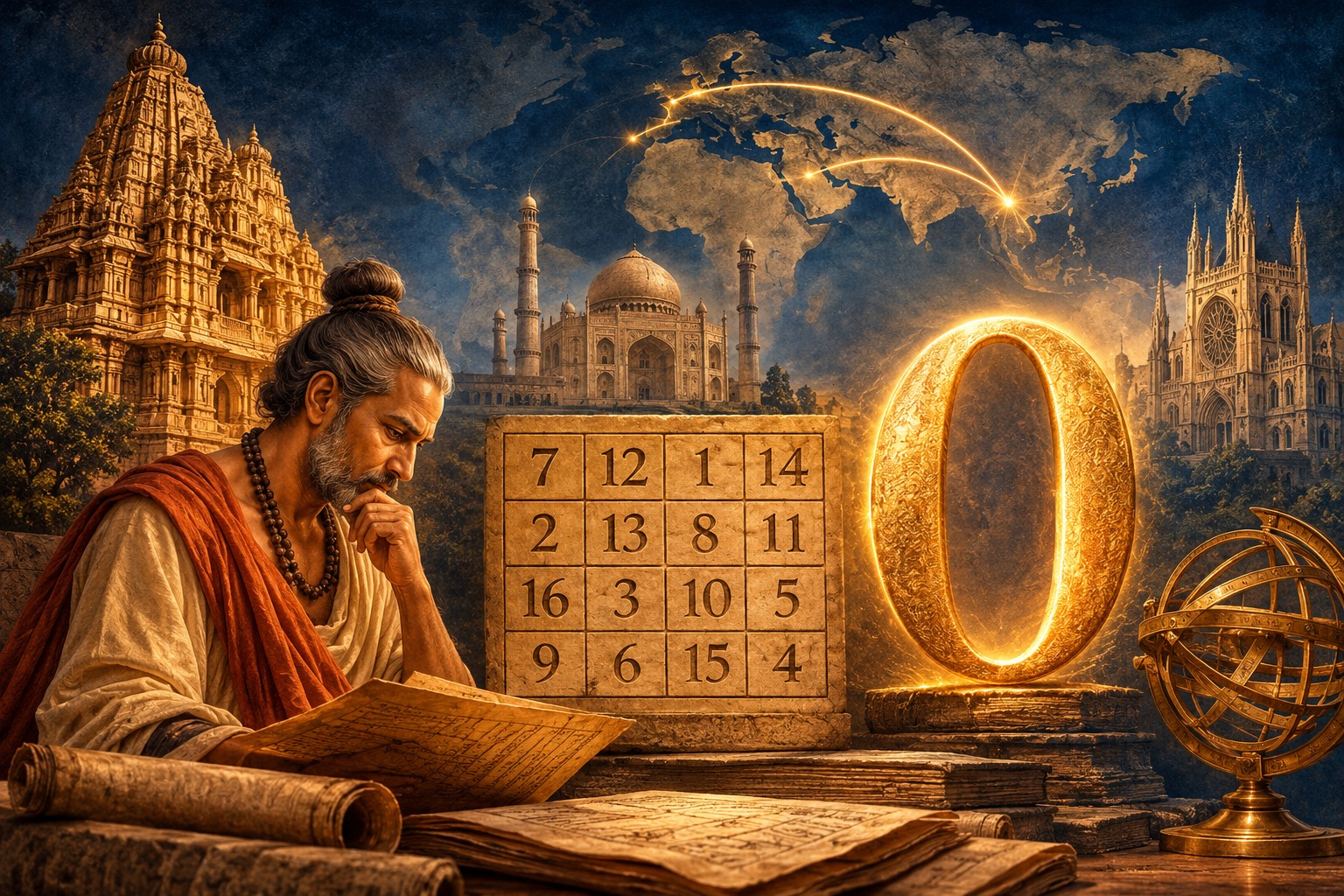
At the Parshvanatha Jain temple complex in Khajuraho, Madhya Pradesh, a remarkable 4 × 4 magic square is preserved in an inscription. It uses the numbers 1 to 16 exactly once.
Every horizontal row adds up to 34: 7 + 12 + 1 + 14 = 34; 2 + 13 + 8 + 11 = 34; 16 + 3 + 10 + 5 = 34; and 9 + 6 + 15 + 4 = 34. The same is true of every vertical column and both main diagonals.
This is the defining property of a magic square: numbers are arranged so that specified lines have the same total. The Khajuraho square is an important example of mathematical pattern-making in the Indian tradition. Its structure also has more intricate properties, which can be explored mathematically rather than simply described as decorative symmetry.
Was it connected to the Chinese Lo Shu square?
Magic squares also appear in Chinese mathematical traditions. The famous Lo Shu is a 3 × 3 arrangement in which the rows, columns and diagonals sum to 15. The existence of magic squares in both regions is fascinating. But similarity alone does not establish that one tradition borrowed the idea from the other. It is better to understand these examples as evidence of mathematical curiosity and the development of structured number patterns in different civilisations.
The Khajuraho inscription is also a reminder that mathematics was not confined to manuscripts or classrooms. Numerical patterns could be preserved in architectural and religious settings.
5. The journey through the Islamic scholarly world
A mathematical idea becomes influential when it travels, is studied, adapted and taught. The decimal place-value system moved beyond India through networks of trade, scholarship, translation and administration.
Al-Khwarizmi and Indian calculation
During the Abbasid period, Baghdad became a major centre of learning. Scholars worked with mathematical and astronomical texts from different traditions, including Indian and Greek sources. One of the most important figures in this history was Muhammad ibn Musa al-Khwarizmi, a ninth-century scholar associated with Baghdad. His work on Indian calculation described methods for using the numeral system and carrying out arithmetic.
The original Arabic text on Indian calculation has not survived in its original form, but its contents are known through later Latin transmission and scholarly reconstruction. Al-Khwarizmi's name also gave rise to the word algorithm, through its Latinised form. His work on algebra helped establish the subject's name in the mathematical vocabulary of later centuries.
The importance of this period lies not simply in the movement of symbols. Scholars explained methods, developed mathematical procedures and made the system accessible to new communities of learners.
Why are the numerals called Hindu-Arabic?
Hindu refers to its Indian origins. Arabic reflects the major role of Arabic-speaking scholars in transmitting, developing and teaching the system to other regions. Neither part of the name tells the whole story by itself. The system's history is one of intellectual exchange across cultures.

6. Afghanistan, Central Asia and Al-Biruni
The geographical region connecting the Indian subcontinent, Persia and Central Asia was an important zone of cultural and scholarly interaction. Cities and regions across this wider area were linked by trade routes, political relationships, travel and the movement of manuscripts and scholars.
Afghanistan's location made it part of this historical landscape. It should be understood as a participant in a broad network of exchange, rather than described as the single origin or sole transmission route of Indian numerals.
Al-Biruni: a scholar who studied India
Abu Rayhan al-Biruni was one of the most remarkable scholars of the medieval period. Born in Khwarazm, he later spent part of his life in Ghazni, in present-day Afghanistan. His work Kitab al-Hind — commonly known as The Book of India — examined Indian intellectual traditions, including religion, philosophy, science and mathematics.
Al-Biruni is particularly valuable because he approached Indian knowledge through sustained study and comparison. His writings help us understand the intellectual connections between India and the wider Islamic world. They also remind us that the movement of knowledge involved scholars who translated, explained, questioned and compared ideas across languages and traditions.
7. The early European record: the Codex Vigilanus
The journey into Europe did not begin with Fibonacci. One important early record is the Codex Vigilanus, compiled in Spain in 976 CE. It contains forms of the nine numeral symbols associated with the Indian system, but not the complete modern notation with zero. Another Spanish manuscript, the Codex Emilianus, dated 992 CE, also contains numeral forms.
These manuscripts are significant because they show that the numerals had reached parts of western Europe before the major expansion of their use in commercial arithmetic. However, appearing in a manuscript and becoming widely used are two different things. The system's adoption in Europe took a long time.

8. Fibonacci and the spread of practical calculation
Leonardo of Pisa, better known as Fibonacci, played a major role in making Hindu-Arabic arithmetic accessible to European readers. In 1202, he produced Liber Abaci, a work that explained calculation using the nine Indian figures and zero.
Fibonacci had encountered commercial arithmetic in the Mediterranean world, including North African settings. His book demonstrated how the system could be used in practical problems involving trade, currency conversion, measurement, interest and other calculations. The value of the book was not that it invented the numerals. It helped explain their usefulness to people who could apply them in everyday commercial and mathematical work.
European adoption was gradual. Older numeral practices continued, and the new notation spread through education, commerce, manuscripts and eventually printed books. The transition was not a single event but a long process of changing habits.
9. Decimal fractions: extending the system
The place-value principle also provides a natural way to represent fractions: 1/10 = 0.1; 1/100 = 0.01; 1/1000 = 0.001. Each position to the right of the decimal point represents a successive negative power of ten.
The history of decimal fractions, however, involved further mathematical developments across different regions. The tenth-century scholar al-Uqlidisi is associated with an early surviving treatment of decimal fractions in Arabic mathematical writing. Later, Jamshid al-Kashi made important contributions to their systematic use.
In Europe, Simon Stevin's 1585 work De Thiende helped promote decimal fractions for practical applications in measurement, commerce and calculation. The important distinction is that Stevin did not invent decimal place value. His work helped make decimal fractions more accessible and useful in European mathematical practice.
10. Why did the Indian positional system become so widely useful?
Compare two ways of writing a number. Roman numerals use letters and combinations of symbols; the decimal positional system uses ten digits, 0–9. Roman notation is not positional in the modern sense, while decimal place value makes position determine value. The decimal system uses zero as an essential placeholder and number, represents large quantities compactly and supports systematic written algorithms. Roman numerals are not incapable of sophisticated work, but they do not provide an equivalent standard decimal-place structure.
The decimal system did not make every calculation effortless. Its advantage was structural. A small set of symbols could represent numbers of any size. The same written procedures could be applied repeatedly. Place value made carrying, borrowing, multiplication and division easier to organise on paper. This made the system particularly suitable for commerce, accounting, scientific work, education and eventually computing.
11. From ancient calculation to the digital world
Today, decimal numbers appear everywhere: financial transactions and business accounts; measurements in science and engineering; school mathematics and examinations; population statistics and economic indicators; navigation, construction and industrial design.
Computers also use positional notation, although their fundamental digital operations generally use binary — a base-2 system built around 0 and 1. The deeper lesson is that positional notation is a powerful mathematical idea that can operate with different bases. The decimal system became the everyday numerical language of much of the world, while binary became central to digital computation.
A system developed and refined over centuries now supports activities that its early practitioners could scarcely have imagined.
12. What should a student understand from this history?
The history of numbers is not just a sequence of dates and famous mathematicians. It helps explain why mathematics works the way it does. A student who understands place value can see why 40 is different from 4; why zero changes the meaning of a number's written position; why 0.5 is different from 0.05; why the same arithmetic principles work with very large and very small numbers; and why a number system is more than a collection of symbols: it is a structured way of representing quantities.
These ideas are the foundation for later work in fractions, decimals, percentages, algebra and higher mathematics.
Conclusion: Ten symbols, a global mathematical language
The modern decimal system is the result of a long history of human problem-solving. Earlier civilisations developed ways to count, record and calculate. Indian mathematicians made foundational contributions to the decimal place-value system and the mathematical treatment of zero. Scholars in the Islamic world studied, transmitted and developed Indian arithmetic. European writers and practitioners helped spread its use through education and commerce.
No single person or civilisation tells the entire story. The achievement is greater when understood as a history of connected intellectual traditions: ideas moving across borders, being translated, tested, refined and made useful. Today, the digits 0 to 9 are so familiar that it is easy to overlook the extraordinary mathematical insight behind them. A small set of symbols changed how humanity represents quantity — and helped make modern mathematics possible.
Further reading and research references
- Menso Folkerts, “Early Texts on Hindu-Arabic Calculation,” Science in Context, Cambridge University Press. Read the scholarly article.
- MacTutor Indian Culture & Heritage, University of St Andrews — historical essays and biographies on Indian numerals and mathematicians. Explore MacTutor.
- Al-Uqlidisi, biography and historical discussion of early decimal fractions. MacTutor biography.
- Al-Biruni, biography and historical context. MacTutor biography.
- Indian Journal of History of Science, “Turagagati method for 4 × 4 pandiagonal magic squares by Nārāyaṇa Paṇḍita” (2024). Read the research paper. This paper reproduces the Khajuraho square in Fig. 4 and dates the inscription to the 11th century; Maya Mohsin Ahmed’s 2004 dissertation describes the Jaina inscription as 12th or 13th century. The exact dating is therefore reported differently in the literature.
- Edition Open Sources, scholarly material on the transmission of Indian arithmetic. Read the source.
- Maya Mohsin Ahmed, Algebraic Combinatorics of Magic Squares, doctoral research. Explore the research record.
Editorial note
Dates and historical interpretations in the history of numerals are subject to continuing scholarly discussion. This article distinguishes established evidence from broader historical interpretation and avoids treating the transmission of mathematics as a single, uninterrupted route.