
UPSC Current Affairs | Beyond the Headlines
QUAD Summit 2026 in Manila: What It Means for India and the Indo-Pacific
What the Manila meeting means for India, regional cooperation and the balance of power in the Indo-Pacific.
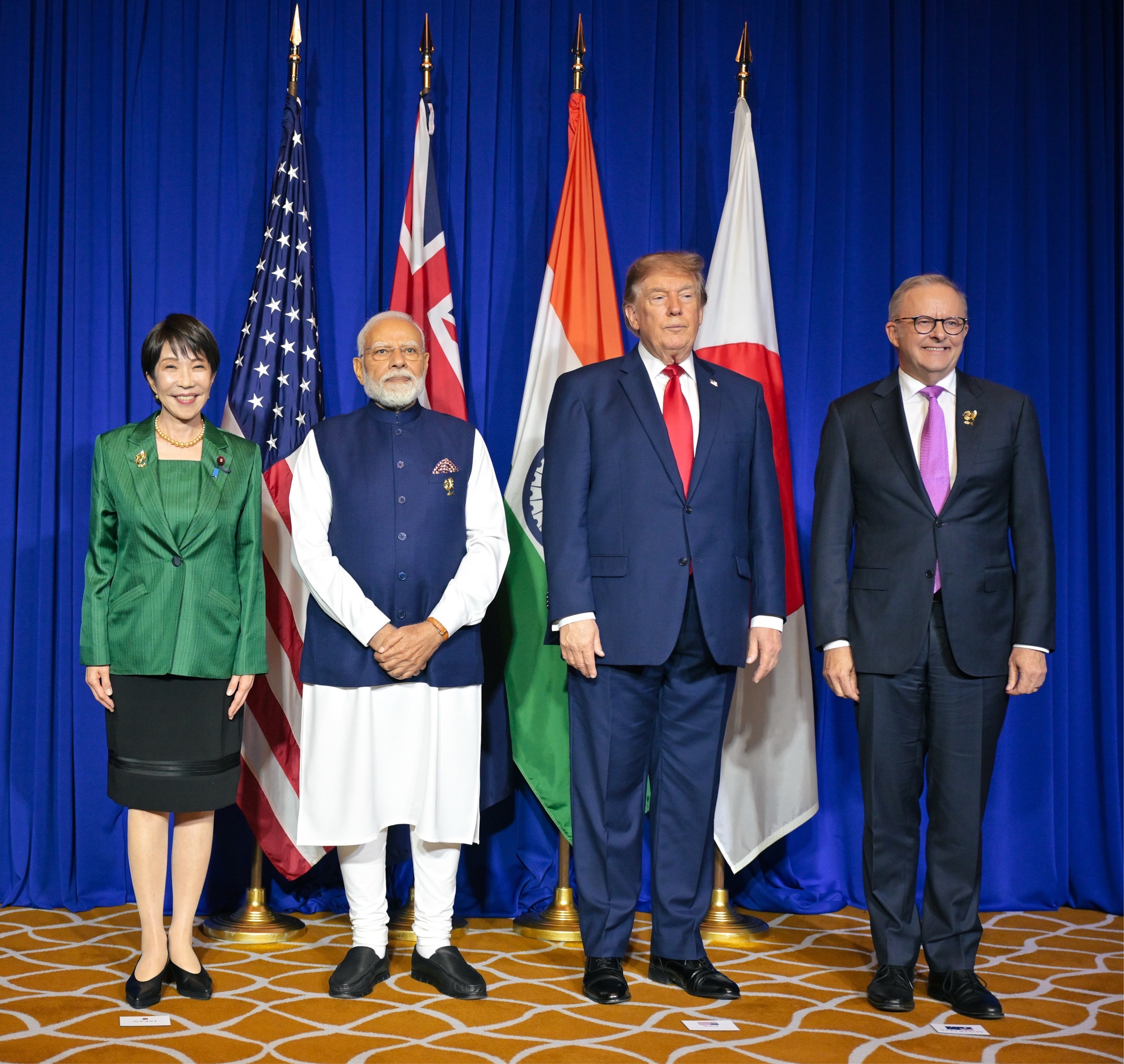
Photo credits: Prime Minister’s Office, Government of India. Official photo sources and reuse terms are provided in each caption.
Meeting: QUAD Leaders’ Summit · Date: 17 November 2026 · Venue: Manila, Philippines · Participants: India, Australia, Japan and the United States.
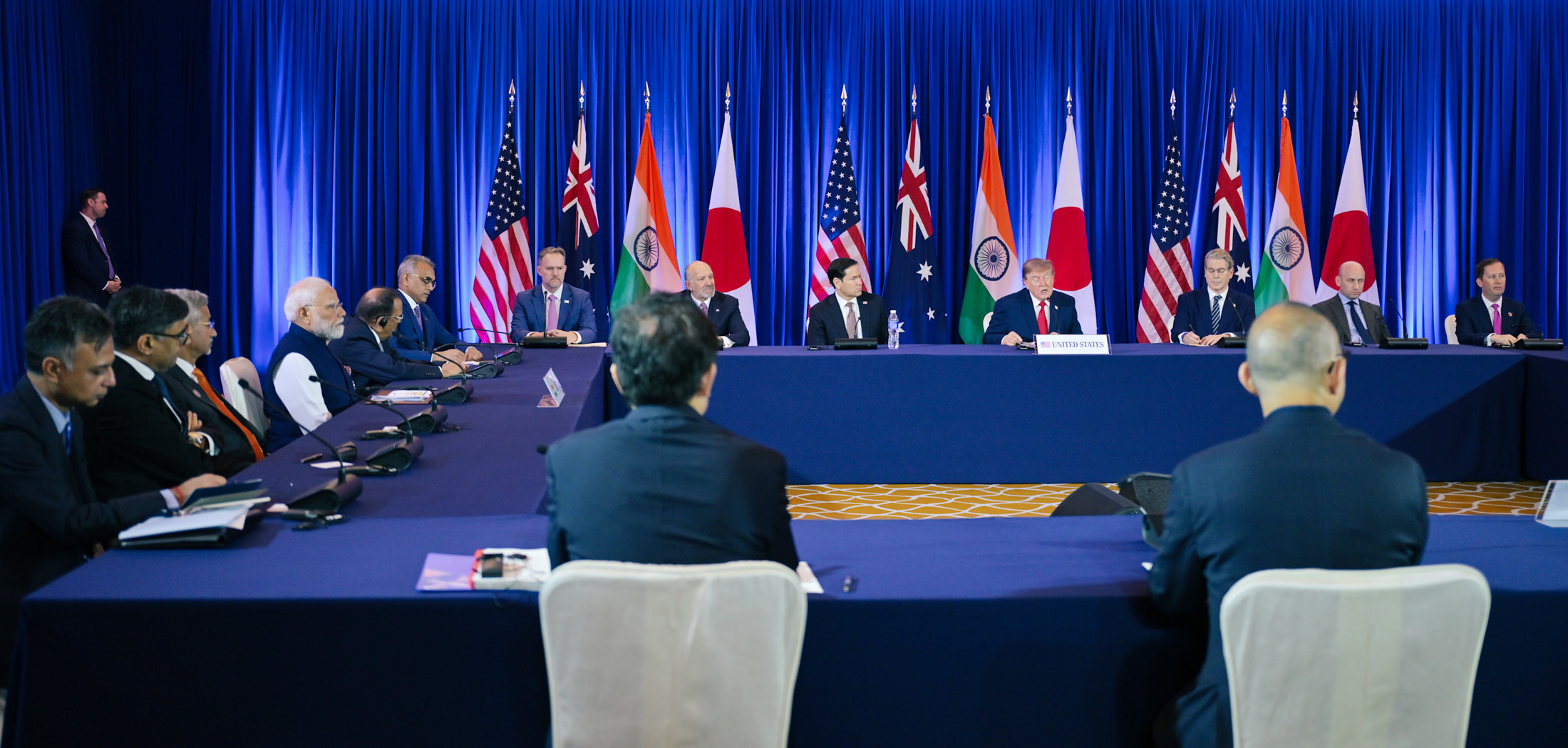
On 17 November 2026, the leaders of India, Australia, Japan and the United States met in Manila for a Quad Leaders’ Summit. The meeting renewed leader-level engagement and placed practical cooperation—maritime awareness, undersea connectivity, cybersecurity, trusted technology and private-sector links—at the centre of the grouping’s agenda.
The summit matters not because it transformed the Quad into a military alliance, but because it sought to connect a shared strategic outlook with specific regional initiatives. The real test will be whether these initiatives receive sustained funding, institutional follow-through and participation from regional partners.
1. What Happened at the QUAD Summit in Manila?
The summit brought together Prime Minister Narendra Modi of India, Prime Minister Anthony Albanese of Australia, Prime Minister Takaichi Sanae of Japan and President Donald J. Trump of the United States. It was held in Manila alongside the Philippines-hosted ASEAN-related summit meetings.
The leaders reaffirmed their commitment to a free and open Indo-Pacific and opposed destabilising or unilateral attempts to change the status quo by force or coercion. They expressed concern about economic coercion, including arbitrary export restrictions, and committed to work for open, safe and resilient maritime transit corridors.
The joint press release set out five practical areas:
- Quad Business Leaders’ Forum: its inaugural meeting is scheduled for early 2027, bringing together business leaders, government officials and policy experts to promote commercial ties and partnerships.
- Super Intelligence Accelerator: the leaders affirmed the importance of the Accelerator, announced by Quad foreign ministers in Atlanta. It is intended to coordinate and fund support for trusted access, deployment and technical assistance across the Indo-Pacific. The release’s footnote says that ‘Super Intelligence’ refers to artificial intelligence in Australia, India and Japan.
- Indo-Pacific Maritime Surveillance Collaboration (IPMSC): a new initiative to enhance information-sharing and maritime domain awareness. In 2027, the partners’ P-8 and P-3C patrol aircraft are scheduled to fly in a maritime exercise for the first time in a Quad context.
- Quad Partnership for Cable Connectivity and Resilience: the leaders welcomed an expansion of Australia’s contribution to focus on electricity cables, as well as upcoming undersea cable projects in the Indian Ocean.
- Enhanced Quad Cybersecurity Cooperation: the partners plan to work together towards an open and secure cyberspace in response to the rapid increase in the number and scale of cyber incidents.
The leaders also condemned terrorism and violent extremism in all forms and manifestations, explicitly including cross-border terrorism, and committed to strengthen ongoing Quad counterterrorism cooperation. They reaffirmed support for ASEAN centrality and unity.
These announcements have different implementation statuses. The Business Leaders’ Forum and patrol-aircraft exercise are scheduled for 2027; the Accelerator is an existing initiative whose importance was reaffirmed; the maritime collaboration was welcomed as a new initiative; and the cable and cybersecurity paragraphs describe expanded or planned cooperation. They should not all be presented as completed projects.
2. Understanding the Manila Agenda: Why Was This Meeting Important?
The Manila meeting took place in a region where maritime security, economic resilience, technological competition and the security of critical infrastructure increasingly overlap. Its location alongside ASEAN-related meetings also carried diplomatic significance.
A. ASEAN centrality and regional architecture
ASEAN centrality refers to ASEAN’s role as a convenor and agenda-shaper in the wider regional architecture. ASEAN-led platforms such as the East Asia Summit and ASEAN Regional Forum provide inclusive settings for dialogue among countries with different interests. The Quad’s reaffirmation of ASEAN centrality signals that its minilateral cooperation is intended to operate alongside, not replace, ASEAN-led mechanisms.
B. Maritime transit corridors
The Indo-Pacific contains major sea lanes through which energy, manufactured goods, food and digital infrastructure components move. Maritime domain awareness helps governments build a clearer picture of vessel movements and activities that may affect security, safety, the economy or the environment. It can support responses to illegal fishing, suspicious shipping, trafficking and risks to maritime infrastructure, while remaining distinct from a collective naval command.
C. Geo-economic resilience
The summit connected strategic stability with economic dependencies. Export restrictions, concentrated supply chains, vulnerable undersea cables and cyber incidents can disrupt national economies without a conventional military confrontation. The Quad’s agenda therefore extends beyond naval cooperation to technology, infrastructure, business partnerships and supply-chain resilience.
D. Regional benefit as a test of credibility
The Quad’s credibility will depend on whether its initiatives deliver practical benefits beyond the four members. Capacity-building, transparent partnerships, affordable connectivity and cooperation with regional institutions can help address concerns that minilateral initiatives may intensify major-power rivalry.
3. What Is the Quad?
The Quad is an informal strategic partnership comprising India, Australia, Japan and the United States. It is not a treaty-based collective-defence alliance. It has no mutual-defence clause, integrated military command or binding obligation requiring one member to defend another.
Its working style is flexible: leaders and foreign ministers provide political direction, while officials and working groups advance practical cooperation. Its agenda spans maritime security, economic prosperity and security, critical and emerging technologies, and humanitarian assistance and emergency response.
The distinction from a formal military alliance is important. Quad members cooperate where interests converge, but retain independent foreign-policy and security decisions. India’s participation therefore does not amount to an automatic military commitment.
Evolution and institutional milestones
The Quad developed in stages—from disaster-response coordination after the 2004 Indian Ocean tsunami to officials’ consultations, leaders’ meetings and a wider programme of practical cooperation.
| Year / date | Milestone | Significance |
|---|---|---|
| 2004 | Indian Ocean tsunami response | The four countries coordinated relief and assistance, providing an operational precedent for cooperation. |
| May 2007 | First officials’ consultations | The first formal quadrilateral consultations took place on the margins of the ASEAN Regional Forum in the Philippines. |
| November 2017 | Revival in Manila | Officials resumed consultations after a gap, on the margins of the East Asia Summit. |
| September 2019 | Foreign Ministers’ level | The first Quad foreign ministers’ meeting took place in New York. |
| March 2021 | Leaders’ level | The first leaders’ summit was held virtually, elevating the political profile of the partnership. |
| May 2022 | IPMDA announced | The Indo-Pacific Partnership for Maritime Domain Awareness was launched at the Tokyo leaders’ summit. |
| May 2023 | Cable partnership | The Quad Partnership for Cable Connectivity and Resilience was announced at Hiroshima. |
| September 2024 | Wilmington summit | Leaders advanced practical cooperation across several sectors. |
| May 2026 | IPMSC announced by foreign ministers | The new maritime surveillance collaboration was announced in New Delhi. |
| 17 November 2026 | Manila leaders’ summit | Leaders welcomed IPMSC and advanced cooperation on cables, cybersecurity, trusted AI and business links. |
4. Deconstructing the Manila Joint Press Release: Core Pillars
The Manila joint press release turns the Quad’s broad strategic outlook into practical areas of cooperation. Its main pillars cover economic resilience, maritime awareness, critical infrastructure, trusted technology, cybersecurity and counterterrorism.
4.1 Economic coercion and supply-chain protection
The leaders expressed grave concern about economic coercion, including arbitrary export restrictions. The underlying issue is the vulnerability created when a country or industry depends heavily on a narrow set of suppliers, markets or strategic inputs. Such dependence can become a source of pressure during political disputes or crises.
For India, more diversified and resilient supply chains can support manufacturing, energy security and access to critical technologies. However, diversification requires investment, viable alternative suppliers, logistics, standards cooperation and domestic industrial capacity; a diplomatic statement alone cannot deliver it.
4.2 Maritime domain awareness: IPMSC and IPMDA
The Manila statement welcomed the Indo-Pacific Maritime Surveillance Collaboration (IPMSC), intended to improve information-sharing and maritime domain awareness. The scheduled 2027 exercise involving P-8 and P-3C patrol aircraft will be the first maritime exercise of this kind in a Quad context.
IPMSC must not be confused with the Indo-Pacific Partnership for Maritime Domain Awareness (IPMDA), launched in 2022. IPMDA supports a broader effort to improve the availability of near-real-time information about activity at sea, including through regional information fusion arrangements. IPMSC is a separate 2026 collaboration. Both contribute to maritime awareness, but they are not interchangeable names.
For India, maritime awareness is relevant to the Indian Ocean’s sea lanes, offshore infrastructure, ports and shipping. Its effectiveness will depend on data quality, interoperability, legal safeguards, information-sharing protocols and the ability of participating states to act on alerts.
4.3 Undersea data and electricity infrastructure
Submarine communications cables carry a substantial share of international data traffic. Damage, disruption or inadequate redundancy can affect finance, cloud services, government communications and everyday connectivity. The Quad Partnership for Cable Connectivity and Resilience seeks to expand access to secure and trusted communications infrastructure.
The Manila release welcomes an expansion of Australia’s contribution to focus on electricity cables and upcoming undersea cable projects in the Indian Ocean. It does not identify particular routes, budgets or completion dates. The policy significance is the recognition that digital connectivity and energy connectivity are increasingly linked to economic and national security.
4.4 Trusted AI and the Super Intelligence Accelerator
The leaders affirmed the importance of the Super Intelligence Accelerator, previously announced by Quad foreign ministers in Atlanta. The initiative is intended to coordinate and fund efforts supporting trusted access, deployment and technical assistance across the Indo-Pacific.
The terminology needs care: the joint release uses ‘Super Intelligence (SI)’ and explains in a footnote that in Australia, India and Japan the term refers to artificial intelligence. The article should preserve this official wording while making the meaning clear to readers.
The wider policy questions include access to compute and expertise, responsible deployment, data governance, cybersecurity, skills and the ability of developing economies to participate in emerging technology ecosystems. The Manila release does not itself establish a common AI regulator or binding regional AI rules.
4.5 Cybersecurity and counterterrorism
The leaders announced enhanced Quad Cybersecurity Cooperation with the stated objective of achieving an open and secure cyberspace. This reflects the growing scale of cyber incidents affecting governments, businesses and critical infrastructure. Cooperation may support information exchange, capacity-building and stronger cyber resilience, but the statement does not create a mutual cyber-defence guarantee.
The leaders separately condemned terrorism and violent extremism, including cross-border terrorism, and committed to strengthen ongoing counterterrorism cooperation. This language is relevant to India’s security concerns, but the joint release does not name a particular country or organisation.
5. India’s Strategic Calculus in the Quad
For India, the Quad’s value lies in practical cooperation that complements national and regional priorities while preserving strategic autonomy. The following dimensions show how New Delhi can assess the opportunities and limits of this partnership.
Strategic autonomy and multi-alignment
India’s participation in the Quad reflects issue-based cooperation rather than exclusive alignment with a bloc. New Delhi works with the United States, Japan and Australia on shared priorities while retaining independent relationships with Russia, West Asian countries and the wider Global South. The absence of a mutual-defence treaty is significant because it leaves India’s decisions on specific security questions to its own assessment.
SAGAR and the Indian Ocean
India’s SAGAR vision—Security and Growth for All in the Region—was articulated in 2015 and emphasises maritime security, capacity-building, sustainable development and cooperation in the Indian Ocean. Quad cooperation on maritime awareness, resilient connectivity and regional public goods can complement some of these priorities. SAGAR remains an Indian policy vision; it is not a Quad programme.
Act East Policy and ASEAN centrality
The Quad can complement India’s Act East Policy by supporting a stable and connected Indo-Pacific. But India’s engagement with Southeast Asia is not conducted through the Quad alone. ASEAN-led forums, bilateral partnerships and the ASEAN–India relationship remain essential. Supporting ASEAN centrality helps India demonstrate that its regional strategy is inclusive rather than organised around exclusive blocs.
Indian Ocean connectivity and security
The reference to upcoming undersea cable projects in the Indian Ocean is directly relevant to India’s geography and regional role. India can contribute through technical expertise, coastal infrastructure, regulatory cooperation and partnerships with island and littoral states. The practical value will depend on project design, financing, redundancy, maintenance and local capacity.
Economic and technological opportunities
The Quad’s focus on supply chains, trusted technology, cybersecurity and business partnerships can support India’s manufacturing and digital ambitions. Yet benefits are not automatic. India will need competitive domestic firms, skilled workers, research capacity, predictable regulation and the ability to convert cooperation into investment and technology diffusion.
6. Quad, China, and the Indo-Pacific Balance of Power
The Quad is sometimes described as an ‘Asian NATO’ or a grouping designed to contain China. That description is analytically incomplete: the Quad has no collective-defence treaty or integrated military command, and its Manila agenda includes business, cables, cyber cooperation, trusted technology and maritime awareness.
At the same time, the grouping operates in a region shaped by strategic competition, maritime disputes, military modernisation and concerns about economic coercion. The joint press release opposes unilateral attempts to change the status quo by force or coercion, but it does not name China in that passage. A careful article should distinguish the regional context from the wording of the official document.
The Quad’s strategic significance lies partly in offering participating countries and regional partners additional options for infrastructure, technology and maritime cooperation. Whether this contributes to stability or intensifies rivalry will depend on transparency, restraint, respect for international law and the delivery of regional public goods.
7. Significance and Limitations of the Quad
The Quad can support practical regional public goods, but it remains a flexible partnership rather than a treaty-based alliance. Its potential benefits must therefore be assessed alongside its institutional and political constraints.
Significance
- Maritime awareness: information-sharing and coordinated surveillance can improve understanding of activity across a vast maritime region.
- Resilient infrastructure: cable cooperation recognises the importance of secure digital and energy connectivity.
- Technology cooperation: trusted AI and cybersecurity initiatives address emerging sources of economic and national vulnerability.
- Supply-chain resilience: cooperation can help diversify critical dependencies and support industrial security.
- Regional public goods: practical cooperation can contribute to disaster response, connectivity and capacity-building.
- Strategic flexibility: the informal structure allows members to cooperate without accepting automatic collective-defence obligations.
Limitations
- No mutual-defence guarantee: the Quad is not a military alliance and does not provide treaty-based collective security.
- Divergent threat perceptions: members have different geographies, security priorities and relationships with other powers.
- Implementation gap: announcements need funding, delivery agencies, timelines, measurable targets and sustained political attention.
- Regional sensitivities: Southeast Asian states may resist arrangements perceived as forcing them to choose sides in major-power competition.
- Interoperability and data concerns: maritime and cyber cooperation require trusted systems, compatible procedures and safeguards.
- Uneven economic capacity: the benefits of technology and infrastructure partnerships may be uneven unless regional partners are included.
8. What Happens Next? Roadmap to 2027
The Manila summit’s importance will ultimately be measured by implementation. A scheduled forum must convene; an announced exercise must take place; cable projects must move from intention to funded construction; and technology cooperation must produce access and capacity rather than remain a diplomatic slogan.
| Initiative | Status at Manila | Next step / test |
|---|---|---|
| Quad Business Leaders’ Forum | Inaugural forum scheduled for early 2027 | Whether it generates substantive commercial partnerships and investment. |
| IPMSC maritime exercise | P-8 and P-3C aircraft scheduled to fly in a maritime exercise in 2027 | Whether the exercise leads to routine information-sharing and improved maritime awareness. |
| Cable Connectivity and Resilience | Australia’s contribution expanded to focus on electricity cables; Indian Ocean undersea projects welcomed | Identify projects, routes, financing, partners, safeguards and delivery schedules. |
| Super Intelligence Accelerator | Importance reaffirmed; intended to coordinate and fund access, deployment and technical assistance | Clarify eligible partners, funding, technical support and responsible-use safeguards. |
| Enhanced Quad Cybersecurity Cooperation | Announced as enhanced cooperation | Translate the objective of an open and secure cyberspace into practical capacity-building and cooperation. |
Conclusion
The Manila summit reinforced the Quad’s evolution into a flexible platform for practical cooperation across maritime security, economic resilience, technology and critical infrastructure. For India, it offers opportunities to strengthen Indian Ocean awareness, diversify partnerships and advance a free and open Indo-Pacific while preserving strategic autonomy and supporting ASEAN centrality. The central test is delivery: the Quad’s long-term relevance will depend less on declarations than on sustained, transparent and regionally beneficial implementation.
Official Sources & Further Reading
- The White House — Quad Leaders’ Summit Joint Press Release, 17 November 2026 — https://www.whitehouse.gov/briefings-statements/2026/11/quad-leaders-summit-joint-press-release/
- Ministry of Foreign Affairs of Japan — Japan-Australia-India-U.S. (Quad) Leaders’ Summit, 17 November 2026 — https://www.mofa.go.jp/fp/nsp/page1e_000691_00003.html
- Prime Minister and Cabinet, Australia — 2026 Quad Leaders’ Summit — https://www.pmc.gov.au/quad/2026-quad-leaders-summit
- Australian Department of Foreign Affairs and Trade — The Quad — https://www.dfat.gov.au/international-relations/regional-architecture/quad
- Ministry of External Affairs, Government of India — Quad (official brief and statements) — https://www.mea.gov.in/
- United States Department of State — Quad cooperation and Foreign Ministers’ statements — https://www.state.gov/
Source note: The White House joint press release and the Japanese and Australian government summit pages are the primary references for the Manila meeting. Historical background and initiative timelines should be cross-checked against the relevant official Quad and MEA pages before publication.
UPSC Preparation Corner
This section is a separate study resource for aspirants. It is not a continuation of the article’s numbered sections.
A. Syllabus mapping
This mapping connects the Quad’s regional, diplomatic and strategic themes with the relevant UPSC General Studies areas.
| UPSC area | Relevance |
|---|---|
| GS-II: International Relations | Bilateral, regional and global groupings; India’s interests in the Indo-Pacific; ASEAN centrality; strategic autonomy. |
| GS-III: Security | Maritime security, cyber security, critical infrastructure, terrorism and cross-border threats. |
| GS-III: Economy and technology | Supply-chain resilience, critical technologies, trusted AI, undersea connectivity and energy security. |
| Prelims | Quad membership, evolution, summit milestones, IPMDA versus IPMSC, cable partnership and institutional character. |
| Interview | India’s multi-alignment, the Quad–ASEAN relationship, China and the regional balance of power. |
B. Prelims high-yield facts
- Members: India, Australia, Japan and the United States.
- Formal usage: the partnership is commonly called the Quad; it is not a treaty-based collective-defence organisation.
- Origins: the four countries coordinated relief after the 2004 Indian Ocean tsunami.
- First officials’ consultations: May 2007, on the sidelines of the ASEAN Regional Forum in the Philippines.
- Revival: November 2017, in Manila, on the margins of the East Asia Summit.
- First foreign ministers’ meeting: September 2019, New York.
- Leaders’ level: first leaders’ summit held virtually in March 2021.
- IPMDA: Indo-Pacific Partnership for Maritime Domain Awareness, launched in 2022.
- Cable partnership: Quad Partnership for Cable Connectivity and Resilience, announced in 2023.
- IPMSC: Indo-Pacific Maritime Surveillance Collaboration, announced by foreign ministers in May 2026 and welcomed by leaders in Manila in November 2026.
- 2027 milestones: inaugural Quad Business Leaders’ Forum and the first Quad-context maritime exercise involving P-8 and P-3C patrol aircraft.
- Super Intelligence footnote: in Australia, India and Japan, ‘Super Intelligence’ refers to artificial intelligence.
C. Prelims practice — 12 questions with explanations
1. With reference to the Quad, consider the following statements: (1) It comprises India, Australia, Japan and the United States. (2) It is a treaty-based collective-defence alliance. (3) Its origins are associated with coordination after the 2004 Indian Ocean tsunami.
Answer: (a) 1 and 3 only
Explanation: Statement 2 is incorrect. The Quad is an informal strategic partnership and has no mutual-defence treaty.
2. The first formal officials’ consultations of the Quad took place in:
Answer: (b) 2007
Explanation: The first quadrilateral consultations took place in May 2007 on the sidelines of the ASEAN Regional Forum in the Philippines. The 2017 meeting was the revival after a period of inactivity.
3. The Quad was revived in November 2017 in:
Answer: (c) Manila
Explanation: Officials resumed consultations in Manila on the margins of the East Asia Summit.
4. Which one of the following best describes IPMDA?
Answer: (a) Indo-Pacific Partnership for Maritime Domain Awareness
Explanation: IPMDA is the 2022 initiative. It should not be confused with IPMSC, the distinct 2026 Indo-Pacific Maritime Surveillance Collaboration.
5. IPMSC was welcomed at the Manila leaders’ summit as an initiative primarily intended to:
Answer: (b) Enhance information-sharing and maritime domain awareness
Explanation: The joint press release describes IPMSC in these terms and schedules a 2027 maritime exercise involving P-8 and P-3C aircraft.
6. Consider the following statements about the Manila summit’s 2027 milestones: (1) The inaugural Quad Business Leaders’ Forum is scheduled for early 2027. (2) P-8 and P-3C aircraft are scheduled to fly in a maritime exercise in a Quad context. (3) Both activities had been completed by November 2026.
Answer: (a) 1 and 2 only
Explanation: Statements 1 and 2 are correct. Statement 3 is incorrect because both are future milestones.
7. The Quad Partnership for Cable Connectivity and Resilience is concerned with:
Answer: (c) Secure and trusted communications infrastructure, with an expanded focus on electricity cables
Explanation: The Manila release welcomes Australia’s expanded contribution focusing on electricity cables and upcoming Indian Ocean undersea cable projects. It does not announce a single regional grid.
8. In the Manila joint press release, ‘Super Intelligence’ is explained by a footnote to mean artificial intelligence in:
Answer: (d) Australia, India and Japan
Explanation: The official footnote specifies these three countries. The wording should be reported accurately rather than assumed to have an identical meaning across all four members.
9. Which of the following is NOT a feature of the Quad?
Answer: (c) An integrated military command with a binding mutual-defence obligation
Explanation: The Quad has no integrated military command or collective-defence treaty.
10. The Quad reaffirmed support for which regional principle in its Manila statement?
Answer: (b) ASEAN centrality and unity
Explanation: The leaders explicitly reaffirmed their support for ASEAN centrality and unity.
11. Consider the following statements: (1) IPMDA and IPMSC are two names for the same initiative. (2) IPMDA was launched in 2022. (3) IPMSC was welcomed by Quad leaders in Manila in 2026.
Answer: (b) 2 and 3 only
Explanation: Statement 1 is incorrect. IPMDA and IPMSC are distinct initiatives with different names and timelines.
12. Which statement most accurately describes the Quad’s position on economic coercion in Manila?
Answer: (a) Leaders expressed concern about economic coercion, including arbitrary export restrictions
Explanation: The release does not name a country in this passage. Any attribution to a specific state belongs to wider geopolitical analysis, not the text of that paragraph.
D. Key concepts and distinctions
These terms clarify the institutional and strategic distinctions needed to discuss the Quad accurately, without confusing cooperation with a formal military alliance.
| Term | Meaning / distinction |
|---|---|
| Quad | Informal strategic partnership of India, Australia, Japan and the US; not a collective-defence alliance. |
| Minilateralism | Cooperation among a relatively small group of countries to pursue specific shared objectives. |
| ASEAN centrality | ASEAN’s convening and agenda-shaping role in the regional institutional architecture. |
| FOIP | Free and Open Indo-Pacific: a vision emphasising openness, freedom, rules, stability and regional prosperity. |
| MDA | Maritime Domain Awareness: understanding activities in the maritime domain that may affect security, safety, economy or environment. |
| IPMDA | Indo-Pacific Partnership for Maritime Domain Awareness; launched in 2022. |
| IPMSC | Indo-Pacific Maritime Surveillance Collaboration; welcomed in 2026, with a Quad-context aircraft exercise scheduled for 2027. |
| Strategic autonomy | India’s ability to make independent foreign-policy and security choices while cooperating with multiple partners. |
| SAGAR | Security and Growth for All in the Region; India’s maritime cooperation vision articulated in 2015. |
| Economic coercion | Use or threatened use of economic restrictions or dependencies to influence another state’s choices. |
| Critical infrastructure | Systems essential to society and the economy, including communications cables, energy networks and digital systems. |
E. Mains practice questions
- 150 words, GS-II: The Quad has evolved from post-tsunami coordination into a platform for practical cooperation in the Indo-Pacific. Discuss.
- 150 words, GS-II: Explain the significance of ASEAN centrality in the context of expanding minilateral groupings such as the Quad.
- 150 words, GS-III: Why has maritime domain awareness become an important element of Indo-Pacific security?
- 250 words, GS-II: Examine the significance of the Quad for India’s Indo-Pacific strategy. How can India balance cooperation through the Quad with strategic autonomy?
- 250 words, GS-II: The Quad is not an Asian NATO, yet it has strategic implications for the regional balance of power. Analyse.
- 250 words, GS-III: Undersea cables are increasingly critical to national security. Discuss the vulnerabilities and the role of international cooperation in protecting them.
- 250 words, GS-III: Assess the opportunities and risks for India arising from cooperation on trusted artificial intelligence and cybersecurity within the Quad.
- 250 words, GS-II: Evaluate the extent to which minilateral arrangements can complement, rather than undermine, multilateral regional institutions.
F. Model answer 1 — The Quad’s evolution and practical cooperation (150 words)
The Quad is an informal strategic partnership of India, Australia, Japan and the United States. Its roots lie in the four countries’ coordination after the 2004 Indian Ocean tsunami. Following officials’ consultations in 2007 and revival in 2017, it was elevated to the leaders’ level in 2021.
Its agenda has expanded beyond strategic dialogue to practical cooperation. Maritime initiatives such as IPMDA and the newer IPMSC seek to improve maritime domain awareness. The cable partnership addresses secure communications infrastructure, while the Super Intelligence Accelerator and enhanced cybersecurity cooperation respond to emerging technological risks. The proposed Business Leaders’ Forum seeks to deepen commercial links.
However, the Quad is not a treaty-based military alliance and has no mutual-defence clause. Its effectiveness depends on implementation, funding, interoperability and regional acceptance. It can contribute to a free and open Indo-Pacific when its initiatives deliver transparent public benefits and complement ASEAN-led institutions.
G. Model answer 2 — Significance of the Quad for India and strategic autonomy (250 words)
The Quad provides India with a flexible platform to cooperate with Australia, Japan and the United States on issues central to the Indo-Pacific, without entering a formal collective-defence alliance. Its significance lies in maritime security, economic resilience and access to critical technologies.
First, maritime cooperation is important for India’s role in the Indian Ocean. IPMDA and IPMSC can improve information-sharing and awareness of shipping activity, while cooperation on undersea cables recognises the strategic importance of digital connectivity. Second, supply-chain resilience and trusted technology initiatives can support India’s manufacturing, digital and energy-security objectives. Third, the Quad creates opportunities for capacity-building and partnerships with regional states.
Yet India must preserve strategic autonomy. Its security interests and external relationships are not identical to those of the other members. The Quad has no mutual-defence obligation, allowing India to cooperate selectively while retaining independent decisions. India must also avoid allowing the grouping to define the region through an exclusive bloc framework.
ASEAN centrality is therefore essential. India should support ASEAN-led platforms such as the East Asia Summit and ASEAN Regional Forum, and ensure Quad projects are transparent, inclusive and responsive to regional priorities.
The way forward is sustained delivery: operational maritime information-sharing, viable cable projects, meaningful technology access and business partnerships. The Quad should remain one instrument within India’s wider multi-aligned foreign policy, not a substitute for it.
H. Model answer 3 — ASEAN centrality and minilateralism (250 words)
ASEAN centrality denotes ASEAN’s role as a convenor and agenda-shaper in the Indo-Pacific’s regional architecture. It is important because Southeast Asia lies at the intersection of major trade routes and strategic competition, while ASEAN includes states with diverse political systems and external relationships.
Minilateral groupings such as the Quad can respond more quickly to specific problems by bringing together a small number of capable partners. In Manila, the Quad advanced cooperation on maritime awareness, cable resilience, cybersecurity and trusted technology. Such initiatives can add resources and practical capacity to regional efforts.
However, minilateralism can create concerns if it appears exclusive, bypasses ASEAN-led institutions or forces smaller states to choose sides. It may also intensify perceptions of bloc competition. These risks are particularly significant in Southeast Asia, where states seek strategic flexibility and an inclusive regional order.
The two approaches need not be competitors. The Quad can provide targeted capabilities while ASEAN-led platforms preserve inclusive dialogue and regional ownership. Cooperation should be transparent, open to appropriate regional partners and aligned with shared priorities such as maritime safety, disaster response, connectivity and cyber resilience.
India has a particular interest in this balance. Its Act East Policy and Indo-Pacific approach depend on strong ties with Southeast Asia. Supporting ASEAN centrality therefore strengthens India’s regional credibility and prevents the Quad from being viewed as an exclusive security bloc.
I. Model answer 4 — Undersea cables and critical infrastructure (250 words)
Undersea communications cables form a critical part of the global digital infrastructure. They carry international data traffic supporting financial transactions, cloud services, government communications, trade and everyday connectivity. Their disruption can therefore create economic and security consequences far beyond the physical location of damage.
These cables face risks from accidental damage, natural hazards, inadequate redundancy, sabotage and cyber-physical threats. Concentration of landing points and limited repair capacity can increase vulnerability. Electricity cables and interconnected energy infrastructure also have strategic importance as countries pursue energy security and regional connectivity.
The Quad Partnership for Cable Connectivity and Resilience seeks to expand secure and trusted communications infrastructure. At Manila, leaders welcomed an expansion of Australia’s contribution to focus on electricity cables and upcoming undersea cable projects in the Indian Ocean. The statement does not specify routes or budgets, making implementation details important.
India can contribute through resilient landing infrastructure, regulatory coordination, technical expertise, repair and maintenance capacity, and partnerships with Indian Ocean littoral states. Regional cooperation should include risk assessment, redundancy planning, information-sharing and clear procedures for responding to outages.
The way forward is to convert political intent into funded and technically viable projects. Transparent procurement, environmental safeguards, diversified routes and local capacity-building will help ensure that connectivity strengthens regional resilience rather than creating new dependencies.
J. Model answer 5 — Quad, China and the balance of power (250 words)
The Quad has strategic implications for the Indo-Pacific balance of power, but describing it simply as an ‘Asian NATO’ is inaccurate. It has no mutual-defence treaty, integrated military command or automatic obligation to respond militarily to an attack on a member.
Its significance lies in coordinated action across maritime awareness, resilient supply chains, critical infrastructure, cybersecurity and emerging technologies. These areas affect the distribution of economic and strategic capabilities. The Manila statement opposed unilateral attempts to change the status quo by force or coercion and expressed concern about economic coercion, without naming a country in those passages.
The wider context includes maritime disputes, military modernisation and concerns about the use of economic dependencies as instruments of pressure. China is therefore relevant to analysis of the regional balance, but the official text should not be inaccurately quoted as naming China where it does not.
For India, the Quad can widen strategic options and strengthen maritime awareness in the Indian Ocean. At the same time, India’s strategic autonomy, continental security priorities and relationships with multiple powers require a calibrated approach.
The way forward is to keep the Quad focused on practical, transparent and regionally beneficial cooperation, while maintaining ASEAN centrality and open channels of dialogue. Its contribution to stability will depend on whether it reduces vulnerabilities and expands regional choices without deepening bloc confrontation.
K. Common mistakes to avoid
- Do not call the Quad a formal military alliance or claim that it has a mutual-defence clause.
- Do not confuse IPMDA (2022) with IPMSC (2026).
- Do not write that the 2027 aircraft exercise or Business Leaders’ Forum has already taken place.
- Do not describe the cable announcement as a completed regional electricity grid or invent cable routes and budgets.
- Do not erase the ‘Super Intelligence’ footnote; explain that it refers to AI in India, Australia and Japan.
- Do not claim the Manila joint release explicitly names China in its economic-coercion paragraph.
- Do not describe cybersecurity cooperation as a collective cyber-defence guarantee.
- Do not treat SAGAR as a Quad initiative; it is India’s own maritime vision.
- Do not present ASEAN centrality as incompatible with the Quad; the Manila statement reaffirms support for it.
L. Quick revision: 60-second recap
Four members: India, Australia, Japan and the United States. Origins: 2004 tsunami response; first officials’ consultations in 2007; revival in 2017; leaders’ level in 2021. Key distinction: informal partnership, not a collective-defence alliance. IPMDA: 2022. Cable partnership: 2023. IPMSC: 2026. Manila outcomes: Business Leaders’ Forum and P-8/P-3C exercise scheduled for 2027; cable cooperation expanded; cybersecurity cooperation enhanced; Super Intelligence Accelerator reaffirmed. India’s lens: maritime security, strategic autonomy, SAGAR, Act East and ASEAN centrality.