
UPSC Current Affairs | Beyond the Headlines
49th ASEAN Summit 2026: What the Outcomes Mean for Southeast Asia and India
The summit’s regional outcomes, ASEAN’s priorities and the implications for Southeast Asia and India.
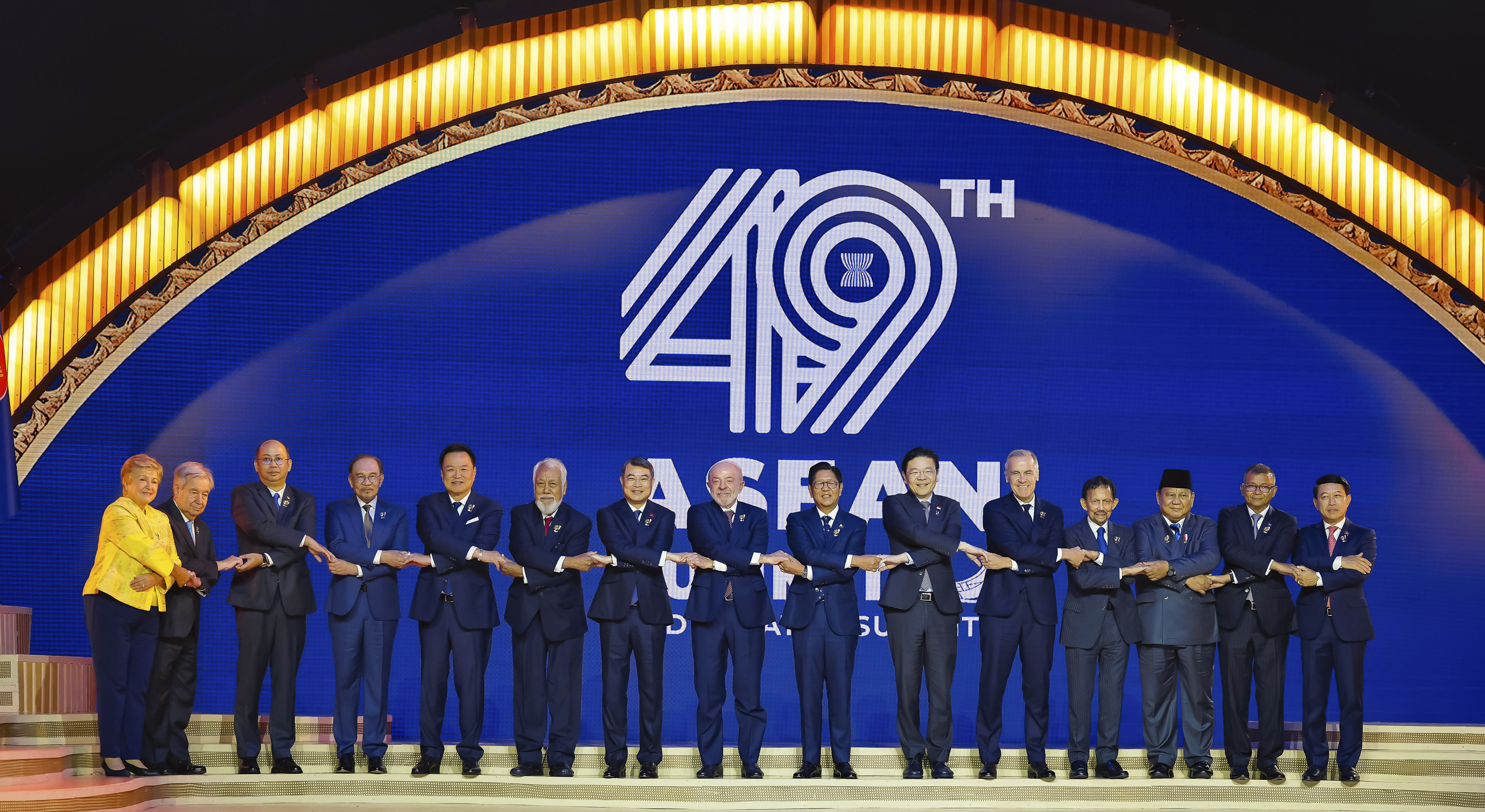
Photo: Ricardo Stuckert / Brazilian Presidency (PR), CC BY-SA 4.0. Original image source.
- Summit: 49th ASEAN Summit
- Dates: 15–17 November 2026 (leaders’ programme; related meetings took place across 14–17 November)
- Venue: Manila, Philippines
- ASEAN Chair for 2026: Philippines
- Chairmanship Theme: “Navigating Our Future, Together”
1. What Happened at the 49th ASEAN Summit?
The 49th ASEAN Summit was held in Manila from 15 to 17 November 2026, bringing together leaders of the Association of Southeast Asian Nations at a time of intensifying geopolitical competition, economic fragmentation, technological change, and regional security concerns.
The Philippines chaired the organisation in 2026 under the theme “Navigating Our Future, Together.” The summit’s agenda reflected a central question facing Southeast Asia: how can a diverse regional grouping preserve unity and strategic relevance while responding to economic uncertainty, maritime tensions, technological disruption, and humanitarian crises?
The summit was not limited to traditional diplomatic declarations. Its outcomes covered several practical areas:
- Digital economic integration through the signing of the ASEAN Digital Economy Framework Agreement (DEFA).
- Regional energy connectivity through the enhanced ASEAN Power Grid framework.
- Supply-chain security and strategic trade management.
- Artificial intelligence adoption and support for micro, small and medium enterprises (MSMEs).
- Cross-border movement of digital talent.
- ASEAN’s response to the continuing crisis in Myanmar.
- Further integration of Timor-Leste into ASEAN’s regional framework.
- A transition of the ASEAN chairmanship from the Philippines to Singapore for 2027.
The summit also took place alongside separate meetings involving ASEAN’s external partners. These included the 23rd ASEAN–India Summit and the 21st East Asia Summit. Their outcomes are relevant to understanding the wider diplomatic calendar, but they should not be confused with decisions taken by ASEAN leaders collectively at the 49th ASEAN Summit.
The official ASEAN outcome page identifies the ASEAN Security Outlook 2026 and the leaders’ review of the Five-Point Consensus on Myanmar among the summit’s principal documents.
2. The Major ASEAN-Wide Outcomes: What Was Decided and Why It Matters
The summit produced a broad set of ASEAN-wide initiatives spanning digital trade, energy connectivity, strategic trade, skills, technology and regional resilience. The sections below explain what each development means and what remains to be implemented.
2.1 ASEAN Digital Economy Framework Agreement: A Major Step Towards a Regional Digital Market
One of the most consequential economic developments was the signing of the ASEAN Digital Economy Framework Agreement (DEFA).
The agreement is intended to provide a common regional framework for digital economic activity. It addresses the need for greater interoperability, more predictable digital rules, and stronger cooperation as commerce increasingly moves across digital platforms.
Its broad areas of relevance include:
- Digital trade and cross-border transactions.
- Digital payments and financial connectivity.
- Data governance and trusted data flows.
- Digital identity and interoperability.
- Cybersecurity and consumer protection.
- Support for businesses adopting digital technologies.
- Cooperation on emerging technologies and digital infrastructure.
The signing followed the conclusion of DEFA negotiations earlier in 2026. ASEAN has indicated that the agreement is expected to enter into force in early 2027, subject to the required processes.
Why does DEFA matter?
ASEAN already functions as a major manufacturing and trade network. However, differences in national regulations, digital standards, payment systems, and data-related rules can create friction for businesses operating across borders.
A common digital framework can reduce some of these barriers. It may help smaller firms access regional markets, encourage digital services trade, and make it easier for businesses to participate in cross-border supply chains. For ASEAN, DEFA is also a strategic response to the growing importance of the digital economy in global competitiveness.
What are the challenges?
A regional framework does not automatically create uniform implementation. ASEAN members have different levels of digital infrastructure, regulatory capacity, cybersecurity preparedness, and economic development. The effectiveness of DEFA will depend on how its commitments are translated into domestic regulations and practical systems. Data protection, privacy, digital inclusion, and the capacity of smaller businesses will remain important concerns.
2.2 ASEAN Power Grid: Regional Energy Connectivity
Energy cooperation was another significant part of the Manila agenda. On 15 November 2026, ASEAN member states completed the signing of the Enhanced Memorandum of Understanding on the ASEAN Power Grid.
The ASEAN Power Grid is a long-term regional initiative intended to connect national electricity systems and facilitate greater cross-border electricity cooperation. The enhanced framework provides for cooperation in areas such as:
- Planning and development of cross-border electricity interconnections.
- Multilateral electricity trade.
- Transmission infrastructure, including overland links and subsea power cables.
- Renewable energy integration.
- Institutional and regulatory arrangements.
- Financing and investment for regional energy infrastructure.
The framework follows a voluntary, step-by-step approach that recognises the national circumstances and autonomy of member states.
Why is this important?
Southeast Asia faces rising electricity demand as its economies expand, urbanisation increases, and industries become more energy-intensive. At the same time, the region needs to manage the transition towards cleaner energy sources. Some countries have significant renewable energy potential, while others have large and growing electricity requirements.
Regional interconnections can help make electricity systems more flexible, allowing countries to exchange surplus electricity, improve supply resilience, and support the integration of renewable energy. However, the ASEAN Power Grid is not a single unified electricity market; its progress depends on infrastructure investment, national regulatory frameworks, commercial arrangements, and political coordination.
2.3 Strategic Trade Management: Protecting Regional Supply Chains
ASEAN leaders adopted the Declaration on Strategic Trade Management for Secure Regional Trade.
The declaration reflects the changing relationship between trade and national security. Strategic goods, sensitive technologies, and critical materials are increasingly affected by export controls, sanctions, geopolitical tensions, and supply-chain disruptions. Strategic trade management seeks to strengthen the ability of states to manage sensitive goods and technologies while facilitating legitimate trade.
For ASEAN, this is particularly relevant because the region is deeply integrated into global manufacturing and logistics networks. The challenge is to balance two objectives:
- Prevent sensitive goods and technologies from being diverted towards prohibited or harmful uses.
- Avoid unnecessary restrictions that disrupt legitimate commerce and regional economic integration.
The declaration signals greater recognition of the need for cooperation in this area, though its effectiveness will depend on implementation capacity, information-sharing, and coordination among national authorities.
Why should India take note?
India is also seeking to strengthen domestic manufacturing, diversify supply chains, and expand cooperation with Southeast Asian economies. A more coordinated regional approach to secure trade can create opportunities for trusted supply-chain partnerships.
2.4 Cross-Border Movement of Digital Talent
ASEAN leaders adopted a declaration on the cross-border movement of digital talent. This initiative recognises that digital transformation requires more than connectivity and technology infrastructure—it also depends on skilled people who can design, operate, and manage digital systems.
The declaration is linked to ASEAN’s broader ambition of building a resilient, innovative, and people-centred regional community under ASEAN Community Vision 2045. The movement of digital professionals can support:
- Greater regional availability of specialised skills.
- Cooperation among technology companies and educational institutions.
- Knowledge-sharing and professional development.
- Innovation and entrepreneurship.
- A more integrated regional digital economy.
However, cross-border mobility requires careful attention to professional recognition, qualifications, immigration rules, labour protections, and differences in national regulations.
2.5 Artificial Intelligence and MSME Development
ASEAN adopted a declaration on AI-powered MSME growth, alongside a broader declaration on strengthening cooperation for micro, small, and medium enterprises. The AI-focused declaration seeks to make artificial intelligence more accessible and useful for smaller businesses through:
- Affordable AI tools and cloud services.
- Public-private partnerships.
- AI literacy and responsible adoption.
- Digital infrastructure and connectivity.
- Capacity-building programmes.
- Support for businesses with limited resources and technical expertise.
Why does this matter?
Large companies are often better positioned to invest in advanced technologies, whereas smaller businesses may lack the capital, skills, and infrastructure required. If AI adoption remains concentrated among large firms, technological change could widen existing economic inequalities. ASEAN’s approach recognises that digital transformation must include smaller enterprises if it is to generate broad-based economic benefits.
2.6 Critical Minerals and Regional Resilience
Critical minerals are becoming increasingly important to clean energy technologies, batteries, semiconductors, electric vehicles, and advanced manufacturing. ASEAN’s regional agenda includes cooperation on critical minerals for resilience and sustainable growth.
The issue is strategically important because the global supply of several minerals and their processing capacity remain geographically concentrated. Regional cooperation can support:
- Greater information-sharing on mineral resources.
- More resilient supply chains.
- Responsible investment and extraction.
- Technology and skills development.
- Environmental and social safeguards.
- Greater value addition within the region.
For India, ASEAN’s critical-minerals agenda creates scope for cooperation in supply-chain diversification, processing, technology, and industrial partnerships.
2.7 Timor-Leste and ASEAN Integration
The integration of Timor-Leste is an important institutional development for ASEAN. Its inclusion strengthens ASEAN’s claim to represent the broader Southeast Asian region and adds another dimension to the organisation’s political and economic diversity. However, membership also creates responsibilities; Timor-Leste will need to build capacity to participate effectively in ASEAN’s extensive network of agreements, meetings, and economic mechanisms.
3. Myanmar: The Continuing Test of ASEAN’s Credibility
The situation in Myanmar remains one of the most serious political and humanitarian challenges confronting ASEAN. At the Manila summit, ASEAN leaders reviewed the implementation of the Five-Point Consensus (5PC), the framework adopted by ASEAN in 2021 to address the crisis.
The leaders expressed deep concern over continuing conflict and the humanitarian situation, reaffirming the Five-Point Consensus as the main reference for ASEAN’s efforts while calling for concrete action to halt violence, protect civilians, and facilitate humanitarian assistance. The review acknowledged the work of the ASEAN Chair’s Special Envoy and the ASEAN Coordinating Centre for Humanitarian Assistance on disaster management (AHA Centre), noting that humanitarian assistance had reached more than 11,000 households, including in additional priority townships.
What is the Five-Point Consensus?
Adopted by ASEAN leaders in April 2021 following the military takeover in Myanmar, its five elements are:
- Immediate cessation of violence in Myanmar.
- Constructive dialogue among all parties concerned.
- Appointment of a special envoy of the ASEAN Chair to facilitate dialogue.
- Provision of humanitarian assistance through ASEAN mechanisms.
- A visit by the special envoy to Myanmar to meet all concerned parties.
Why has implementation been difficult?
The Five-Point Consensus has faced serious implementation challenges. The conflict involves multiple actors, competing political claims, and a deteriorating security environment. Because ASEAN operates through consultation and consensus, it faces structural hurdles in adopting coercive measures against a member state.
The organisation must constantly balance:
- Respect for sovereignty and non-interference.
- Its responsibility to preserve regional peace and stability.
- The humanitarian needs of Myanmar’s population.
- The credibility of ASEAN’s collective commitments.
- The need to maintain channels for diplomatic engagement.
4. ASEAN Community Vision 2045: The Long-Term Direction
The Manila summit must also be understood in the context of ASEAN Community Vision 2045, which provides a long-term framework for building a resilient, innovative, dynamic, and people-centred ASEAN.
The 2026 outcomes directly operationalise elements of this ambition—DEFA advances digital integration, the Power Grid supports energy connectivity, strategic trade management addresses resilience, and AI/MSME initiatives target inclusive growth. This proves that ASEAN’s integration agenda has expanded far beyond conventional trade liberalisation into technology, infrastructure, energy, skills, and economic security.
5. The Wider Diplomatic Calendar: ASEAN–India and East Asia Summit Outcomes
The 49th ASEAN Summit was held alongside several related high-level forums. Two are especially critical for India: the 23rd ASEAN–India Summit and the 21st East Asia Summit.
5.1 The 23rd ASEAN–India Summit
Prime Minister Narendra Modi participated in the 23rd ASEAN–India Summit in Manila on 17 November 2026, reaffirming India's commitment to ASEAN unity, centrality, and a free, open, inclusive, and rules-based Indo-Pacific. The summit adopted the ASEAN–India Joint Statement on Cooperation in Disaster Management. Furthermore, both sides advanced cooperation across multiple domains:
- Maritime Cooperation: A long-term ASEAN–India Maritime Cooperation Plan covering connectivity, scientific research, disaster management, Coast Guard cooperation, maritime domain awareness, and seafarers’ security.
- Cybersecurity: A Joint Cyber Forensics Training Programme to strengthen regional capacity.
- Nuclear Energy: Technical exchanges on civil nuclear energy.
- Space Cooperation: An ASEAN–India Space Hackathon.
- Critical Minerals: Joint cooperation in mining and critical minerals.
- Youth & Education: ASEAN–India Youth Connect (youth summits, young parliamentarian exchanges, start-up hackathons) and enhanced scholarships for ASEAN students at Nalanda University.
- Creative Industries & Tourism: An ASEAN–India Creative Partnership Pavilion at WAVES 2027 and free e-visas for tourists from ASEAN countries visiting India.
5.2 The 21st East Asia Summit
Operating as a separate leaders-led strategic forum, India announced several major initiatives at the 21st East Asia Summit:
- A Seafarers’ Safety Initiative focused on joint training and emergency response.
- An East Asia Summit Cyber Crime Conference at the National Forensic Science University.
- An East Asia Summit Maritime Heritage Festival in Lothal.
- An East Asia Summit University Conclave in Nalanda.
The East Asia Summit also adopted standalone documents targeting online scams, related offences, regional stability, and renewal.
6. What the 49th ASEAN Summit Means for India
The summit’s outcomes matter to India because they affect the neighbourhood in which the Act East Policy operates. The following areas show where regional decisions create opportunities for Indian cooperation, connectivity and economic engagement.
6.1 Act East Policy and Regional Integration
ASEAN remains the anchor of India’s Act East Policy. The summit’s intense focus on digital trade, energy grids, supply-chain security, and critical minerals creates expansive fresh terrain for New Delhi to deepen bilateral and multilateral cooperation.
6.2 Maritime Security and the Indo-Pacific
With the Indian Ocean and the western Pacific tightly linked through trade and security lines, India and ASEAN share profound convergence in protecting freedom of navigation, maritime domain awareness, search and rescue, and anti-piracy operations. The new ASEAN–India Maritime Cooperation Plan institutionalises this alignment while fully respecting ASEAN centrality.
6.3 Supply Chains and Critical Minerals
As India scales up its domestic manufacturing base (e.g., electronics, semiconductors, pharmaceuticals), ASEAN serves as an indispensable production and supply-chain partner. Cooperation on critical minerals, processing value-addition, and logistics integration can yield highly resilient economic networks.
6.4 Digital Economy and Technology
With India's advanced expertise in Digital Public Infrastructure (DPI) and digital payments, DEFA opens practical pathways for dialogue on digital identity, cybersecurity, and AI capacity-building. However, India must tailor its approach to match ASEAN’s internal regulatory diversity.
6.5 Energy and Climate Cooperation
The ASEAN Power Grid offers a blueprint for regional energy interconnections. India can leverage this framework to collaborate on renewable energy integration, grid management technologies, and climate adaptation strategies.
6.6 Balancing Major-Power Competition
Southeast Asia is a core theatre of strategic friction between major global powers. Because ASEAN members fiercely protect their strategic autonomy and resist binary alignments, India’s engagement must continue reinforcing regional inclusiveness, mutual benefit, and absolute respect for ASEAN centrality.
7. ASEAN: Background, Structure, and Institutional Importance
- Establishment: Founded on 8 August 1967 via the Bangkok Declaration by Indonesia, Malaysia, the Philippines, Singapore, and Thailand.
- Expansion: Brunei (1984), Vietnam (1995), Laos & Myanmar (1997), Cambodia (1999), and Timor-Leste (2025), bringing the total membership to 11 states.
- The Three Community Pillars:
- ASEAN Political-Security Community (APSC): Focuses on political cohesion, conflict prevention, and transnational security.
- ASEAN Economic Community (AEC): Drives economic integration, trade liberalisation, and market competitiveness.
- ASEAN Socio-Cultural Community (ASCC): Promotes human development, education, environmental protection, and cultural ties.
- The "ASEAN Way": Traditional reliance on consultation, consensus, and non-interference, which preserves sovereign equality but can constrain swift responses to urgent security crises.
8. Historical Evolution of ASEAN
ASEAN’s present role reflects a gradual institutional evolution, from its founding in 1967 to a wider community with established political, economic and socio-cultural pillars.
| Year | Development | Significance |
|---|---|---|
| 1967 | Bangkok Declaration | ASEAN established by five founding members. |
| 1976 | Treaty of Amity and Cooperation (TAC) | Principles of peaceful relations, sovereignty and non-interference. |
| 1992 | ASEAN Free Trade Area (AFTA) launched | A major step towards regional trade liberalisation. |
| 1995–1999 | Viet Nam, Lao PDR, Myanmar and Cambodia join | ASEAN expands across mainland Southeast Asia. |
| 2003 | Bali Concord II | Roadmap towards an ASEAN Community with three pillars. |
| 2007 | ASEAN Charter signed | Formal legal and institutional framework; entered into force in 2008. |
| 2015 | ASEAN Community established | Political-Security, Economic and Socio-Cultural pillars brought together. |
| 2020 | RCEP signed | Wider Asia-Pacific trade and economic integration; entered into force from 2022 for initial parties. |
| 2021 | Five-Point Consensus on Myanmar | ASEAN diplomatic framework responding to the crisis. |
| 2025 | Timor-Leste admitted as 11th member | ASEAN expands to all 11 states of Southeast Asia. |
| 2025 | ASEAN Community Vision 2045 adopted | Long-term direction: resilient, innovative, dynamic and people-centred ASEAN. |
| 2026 | 49th ASEAN Summit, Manila | Advances digital, energy, trade-security, technology and sustainability cooperation. |
- 1967: Bangkok Declaration establishes ASEAN.
- 1976: Treaty of Amity and Cooperation (TAC) embeds principles of peaceful coexistence.
- 1990s: Regional expansion incorporates Vietnam, Laos, Myanmar, and Cambodia.
- 1992: Launch of the ASEAN Free Trade Area (AFTA).
- 2003: Bali Concord II lays out the roadmap for the three-pillar ASEAN Community.
- 2007: Adoption of the formal legal ASEAN Charter.
- 2015: Formal launch of the integrated ASEAN Community.
- 2020: Signing of the Regional Comprehensive Economic Partnership (RCEP).
- 2021: Adoption of the Myanmar Five-Point Consensus.
- 2025: Timor-Leste formally joins as the 11th member.
- 2026: Manila Summit advances digital economy frameworks, power grids, and strategic trade rules.
9. Limitations and Challenges Facing ASEAN
- The Consensus Constraint: While consensus maintains solidarity, it paralyzes rapid collective action during severe political crises like Myanmar.
- South China Sea Disputes: Competing maritime claims among member states complicate collective stances against external assertions.
- Developmental Asymmetries: Massive disparities in income and institutional capacity across member states lead to uneven implementation of regional pacts.
- External Pressure: Major-power rivalry tests ASEAN's unity and diplomatic dexterity.
- The Implementation Gap: High-level political declarations frequently face bottlenecks during domestic translation and enforcement.
10. What Happens Next? ASEAN’s Roadmap Beyond Manila
The next phase will be judged by whether summit commitments move into implementation. The roadmap below highlights the initiatives and milestones to watch beyond the Manila meetings.
| Initiative / Sector | Next Stage / Milestone to Watch |
|---|---|
| ASEAN Digital Economy Framework Agreement (DEFA) | Expected entry into force in early 2027, subject to domestic ratification processes. |
| ASEAN Power Grid | Rollout of cross-border transmission infrastructure and multilateral trading rules. |
| Strategic Trade Management | Harmonisation of national export control policies and enforcement mechanisms. |
| Digital Talent Mobility | Establishment of mutual recognition frameworks for professional skills. |
| AI-Powered MSMEs | Practical deployment of affordable tools, digital literacy, and cloud access. |
| Myanmar Crisis | Ongoing pressure for humanitarian access, violence cessation, and political dialogue via the 5PC. |
| Incoming Chairmanship | Singapore assumes the ASEAN Chair on 1 January 2027 under the theme "Deeper Integration, Wider Partnerships" during ASEAN’s 60th anniversary year. |
11. Way Forward: What Should ASEAN Prioritise?
- Enhance Implementation Capacity: Attach strict timelines, responsible institutions, secure financing, and measurable progress metrics to regional declarations.
- Balance Unity with Crisis Management: Maintain active diplomatic engagement on Myanmar while scaling up humanitarian delivery channels.
- Inclusive Digital Integration: Back DEFA with robust cybersecurity safeguards, digital literacy training, and direct support for smaller enterprises.
- Accelerate Sustainable Energy Networks: Develop the ASEAN Power Grid with strict adherence to environmental safeguards, grid resilience, and national energy priorities.
- Secure Regional Supply Chains: Align strategic trade rules and critical-mineral frameworks to foster transparent, sustainable, and diversified industrial investments.
- Preserve ASEAN Centrality: Ensure ASEAN-led platforms remain the primary diplomatic architecture for managing major-power engagement in the region.
- Deepen Multi-Aligned Partnerships: Expand cooperation with India, Japan, Australia, the US, and the EU on principles of mutual transparency and strategic autonomy.
Conclusion: Integration Will Be Judged by Delivery
The 49th ASEAN Summit advanced a wide-ranging agenda: digital economic integration, electricity connectivity, secure trade, talent mobility, AI-enabled MSME development, critical minerals, space cooperation, creative industries and environmental restoration. It also exposed the continuing difficulty of securing political progress on Myanmar.
For India, the summit reinforces ASEAN’s importance to Act East and Indo-Pacific engagement. The opportunity is to deepen practical cooperation in maritime affairs, digital technology, energy, skills, supply chains and connectivity while respecting ASEAN centrality. Ultimately, ASEAN’s relevance will be judged not by the number of declarations it adopts, but by whether those commitments improve regional resilience, prosperity and the lives of its people.
Official Sources & Further Reading
The following are direct official documents or institutional pages used to verify the article. For publication, link each title directly to the relevant page/document rather than linking repeatedly to a generic homepage.
- ASEAN — 49th ASEAN Summit and Related Summits: official outcome-document index — Primary index for the summit outcome documents.
https://asean.org/49th-asean-summit-and-related-summits/ - ASEAN — DEFA signing ceremony, 14 November 2026 — Confirms signing date and expected early-2027 entry into force.
https://asean.org/secretary-general-of-asean-attends-the-signing-ceremony-of-the-asean-digital-economic-framework-agreement-defa/ - ASEAN — Enhanced MoU on the ASEAN Power Grid, 15 November 2026 — Confirms all-member signing, scope, voluntary stepwise approach and entry into force.
https://asean.org/asean-advances-regional-power-connectivity-as-all-member-states-sign-enhanced-mou-on-the-power-grid-ahead-of-philippine-chairships-conclusion/ - ASEAN — Leaders’ Review and Decision on the Five-Point Consensus, 15 November 2026 — Primary source for Myanmar review and decisions.
https://asean.org/asean-leaders-review-and-decision-on-the-implementation-of-the-five-point-consensus-4 - ASEAN — Declaration on Strategic Trade Management for Secure Regional Trade — Primary source for STM principles and follow-up.
https://asean.org/asean-leaders-declaration-on-strategic-trade-management-for-secure-regional-trade/ - ASEAN — Declaration on Cross-Border Movement of Digital Talent — Primary source for talent mobility and national-law safeguards.
https://asean.org/asean-leaders-declaration-on-cross-border-movement-of-digital-talent/ - ASEAN — Declaration on AI-Powered MSME Growth — Primary source for AI and MSME agenda.
https://asean.org/asean-leaders-declaration-on-an-ai-powered-msme-growth/ - ASEAN — Declaration on ASEAN Critical Minerals — Primary source for minerals cooperation.
https://asean.org/declaration-on-asean-critical-minerals-for-regional-resilience-and-sustainable-growth/ - ASEAN — Declaration on Space Science, Technology and Innovation Cooperation — Primary source for space cooperation.
https://asean.org/asean-leaders-declaration-on-the-advancement-of-space-science-technology-and-innovation-cooperation/ - ASEAN — Declaration establishing the ASEAN Centre of Excellence for Creative Industries — Primary source for creative-industry initiative.
https://asean.org/asean-leaders-declaration-on-the-establishment-of-the-asean-center-of-excellence-for-creative-industries-ace-ci/ - ASEAN — One Billion Trees Growing Initiative — Primary source for environmental declaration.
https://asean.org/asean-leaders-declaration-on-the-one-billion-trees-growing-initiative/ - ASEAN — Timor-Leste admitted as 11th member, 26 October 2025 — Confirms admission date and membership status.
https://asean.org/forging-a-new-era-timor-leste-admitted-into-asean/ - ASEAN — About ASEAN — Founding date, founding members and membership chronology.
https://asean.org/about-asean - ASEAN — ASEAN Community Vision 2045 — Long-term vision adopted at the 46th Summit in May 2025.
https://asean.org/asean-community-vision-2045-resilient-innovative-dynamic-and-people-centred-asean/ - ASEAN — Singapore chairship handover, 17 November 2026 — Confirms 1 January 2027 start and chairship theme.
https://asean.org/secretary-general-of-asean-attends-the-closing-ceremony-of-the-49th-asean-summit-and-related-summits-and-handover-of-the-asean-chairmanship-to-singapore/ - Philippine Presidential Communications Office — 49th Summit closing and chairship handover — Additional host-government account of handover and summit priorities.
https://pco.gov.ph/news_releases/wins-for-filipinos-under-ph-chairship-carry-into-2027-as-pbbm-hands-asean-chair-to-singapore/ - ASEAN — 49th Summit opening, 15 November 2026 — Confirms opening and chair.
https://asean.org/secretary-general-of-asean-attends-the-opening-ceremony-of-the-49th-asean-summit-and-related-meetings-in-manila-the-philippines/
Editorial note
The article distinguishes an agreement’s signing from its entry into force, an adopted declaration from implementation, and ASEAN-wide decisions from partner-summit initiatives. The 19 November 2026 cut-off is used for status language. Before web publication, the editor should recheck any later changes to DEFA ratification/entry into force, the implementation of the APG, the Myanmar situation and the operational details of announced ASEAN–India and EAS initiatives.
Prepared as the final content master for editorial review. No website, carousel, category, image or deployment changes have been made.
UPSC Preparation Corner
This section is a separate learning resource for aspirants. It is designed to move from factual recall to conceptual understanding, analytical framing and answer construction.
A. Prelims: High-Yield Facts and Distinctions
Use this table to revise the foundational facts and avoid common factual traps about ASEAN and the Manila summit.
| Topic | Fact to retain | Common trap |
|---|---|---|
| Establishment | 8 August 1967; Bangkok Declaration; five founding members. | Do not confuse the founding five with current membership. |
| Membership | 11 members after Timor-Leste joined on 26 October 2025. | Timor-Leste was not admitted at the 49th Summit. |
| Secretariat | Jakarta, Indonesia. | ASEAN is not headquartered in Manila. |
| ASEAN Charter | Signed in 2007; entered into force in 2008. | Adoption/signature and entry into force are different dates. |
| Three pillars | APSC, AEC and ASCC. | ASEAN is not only an economic grouping. |
| ASEAN Way | Consultation, consensus, sovereignty and non-interference. | Not majority voting or supranational command. |
| DEFA | Signed 14 November 2026; expected to enter into force in early 2027, subject to required processes. | Not yet in force at the 19 November 2026 cut-off. |
| ASEAN Power Grid | Enhanced MoU signing completed 15 November 2026; entered into force upon completion of signing. | Not a single unified electricity market. |
| Strategic Trade Management | Declaration adopted; envisages an ASEAN Expert Group under AEC. | Not a blanket export ban or common customs authority. |
| Digital talent | Declaration recognises mobility while preserving national immigration and labour rules. | Not an unconditional right to work throughout ASEAN. |
| Myanmar 5PC | Adopted in April 2021; five elements include cessation, dialogue, envoy, aid and envoy visit. | It is a diplomatic framework, not a peace treaty. |
| 2026 chair | Philippines; theme “Navigating Our Future, Together”. | Chairship changes annually. |
| 2027 chair | Singapore; “Deeper Integration, Wider Partnerships”. | Handover occurred in November 2026; Singapore assumes office 1 January 2027. |
| ASEAN Vision 2045 | Adopted in May 2025; “Resilient, Innovative, Dynamic, and People-Centred ASEAN”. | Not first adopted at Manila 2026. |
B. Concepts and Terms for Analytical Use
The concepts below provide concise definitions and analytical context for using ASEAN-related terms accurately in a General Studies answer.
| Term | Meaning and relevance |
|---|---|
| ASEAN centrality | ASEAN’s role as a convenor and agenda-shaper in regional architecture and dialogue. It does not mean ASEAN controls all regional outcomes. |
| ASEAN Way | Consultation, consensus, sovereignty, non-interference and gradualism; a source of cohesion but sometimes a constraint on crisis response. |
| DEFA | Regional framework for digital economic integration; relevant to digital trade, interoperability, trust and regulatory cooperation. |
| ASEAN Power Grid | Regional electricity interconnection initiative; links energy security, renewable integration, infrastructure finance and regional resilience. |
| Strategic Trade Management | Controls and procedures for sensitive and dual-use goods; aims to balance security with legitimate trade facilitation. |
| Dual-use items | Goods, software or technologies with both civilian and potential military or security applications. |
| Digital talent mobility | Movement of skilled digital professionals under national laws and relevant regional qualification and mobility arrangements. |
| Critical minerals | Minerals important to energy, digital and advanced industrial technologies; supply-chain security must be balanced with sustainability. |
| Five-Point Consensus | ASEAN’s 2021 framework for Myanmar; its limited implementation tests ASEAN credibility. |
| Strategic autonomy | Ability to retain independent policy choices and partnerships without exclusive alignment with a major power. |
| ASEAN Community Vision 2045 | Long-term vision adopted in 2025 for a resilient, innovative, dynamic and people-centred ASEAN. |
| Regional public goods | Benefits such as stable sea lanes, disaster preparedness, interoperable infrastructure and environmental protection that extend across borders. |
C. The Summit: What Is an Outcome and What Is Not?
This status table separates signed or adopted documents from announcements, proposals and initiatives that still require implementation.
| Development | Correct status at 19 Nov 2026 | How to write it in an answer |
|---|---|---|
| DEFA | Signed 14 Nov; expected to enter into force early 2027, subject to processes. | “Signed framework; entry into force expected, not yet effective.” |
| Enhanced APG MoU | All member-state signatures completed; MoU entered into force upon completion of signing. | “Strengthened framework for voluntary, stepwise interconnections and electricity trade.” |
| Strategic Trade Management | Leaders’ declaration adopted; Expert Group envisaged. | “Political commitment and institutional follow-up, not a single harmonised export-control law.” |
| Digital talent | Leaders’ declaration adopted; national laws continue to govern entry and employment. | “Framework for cooperation, not free movement without conditions.” |
| Myanmar | Leaders’ review and decision adopted; insufficient progress acknowledged. | “5PC reaffirmed as main reference; implementation remains limited.” |
| Timor-Leste | Member since 26 Oct 2025; integration continues. | “11th member; ongoing institutional integration.” |
| ASEAN–India initiatives | Announced/advanced in the separate 23rd ASEAN–India Summit. | Attribute to ASEAN–India Summit, not 49th ASEAN Summit. |
| EAS initiatives | Announced/adopted in the separate 21st East Asia Summit. | Attribute to EAS, not 49th ASEAN Summit. |
D. Prelims Practice: 12 Questions with Explanations
1. With reference to ASEAN, consider the following statements: (1) It was established through the Bangkok Declaration. (2) Its Secretariat is located in Jakarta. (3) Timor-Leste became its 11th member in 2025. Which are correct?
A. 1 only B. 1 and 2 only C. 2 and 3 only D. 1, 2 and 3
Answer: D. All three are correct. ASEAN was established on 8 August 1967; its Secretariat is in Jakarta; Timor-Leste was admitted on 26 October 2025.
2. Which of the following are the three pillars of the ASEAN Community?
A. Political-Security, Economic, Socio-Cultural B. Political, Monetary, Defence C. Trade, Customs, Currency D. Security, Energy, Technology
Answer: A. The three pillars are the ASEAN Political-Security Community, ASEAN Economic Community and ASEAN Socio-Cultural Community. ASEAN does not have a common currency or unified defence command.
3. Consider the following statements about DEFA: (1) Its signing ceremony was held on 14 November 2026. (2) It was expected to enter into force in early 2027. (3) It establishes a single ASEAN currency. Which are correct?
A. 1 only B. 1 and 2 only C. 2 and 3 only D. 1, 2 and 3
Answer: B. Statements 1 and 2 are correct. DEFA concerns digital economic integration; it does not create a common currency. Entry into force was expected, not already achieved, at the editorial cut-off.
4. The Enhanced MoU on the ASEAN Power Grid is best described as:
A. A single ASEAN electricity regulator B. A unified regional electricity market already operating C. A framework for voluntary, stepwise power interconnections and electricity trade D. A common petroleum reserve
Answer: C. The MoU strengthens planning, institutional, regulatory and financing cooperation for interconnections. It respects national autonomy and does not itself create a single market.
5. Strategic Trade Management is especially relevant to which category of goods?
A. Only agricultural commodities B. Dual-use goods and sensitive technologies C. Only consumer electronics D. All goods subject to an identical regional tariff
Answer: B. Dual-use items have civilian uses but may also have military or security applications. STM aims to balance trade facilitation with controls against diversion and prohibited end uses.
6. Consider the following statements on the ASEAN digital talent declaration: (1) It recognises regional cooperation on digital skills and talent. (2) It removes all national immigration and work-permit requirements. (3) It builds on existing regional arrangements such as qualifications frameworks and mutual recognition arrangements. Which are correct?
A. 1 only B. 1 and 3 only C. 2 and 3 only D. 1, 2 and 3
Answer: B. The declaration supports cooperation but expressly preserves each member state’s authority over entry, stay, labour-market access and employment under national laws.
7. Which of the following is NOT one of the five elements of the Myanmar Five-Point Consensus?
A. Cessation of violence B. Constructive dialogue C. Appointment of a special envoy D. Establishment of a permanent ASEAN military force in Myanmar
Answer: D. The 5PC concerns cessation of violence, dialogue, an ASEAN Chair’s special envoy, humanitarian assistance and a visit by the envoy to meet concerned parties.
8. Consider the following statements: (1) ASEAN Community Vision 2045 was adopted in 2025. (2) Its stated ambition is a resilient, innovative, dynamic and people-centred ASEAN. (3) It was first adopted at the 49th Summit in Manila. Which are correct?
A. 1 and 2 only B. 2 and 3 only C. 1 and 3 only D. 1, 2 and 3
Answer: A. Vision 2045 was adopted at the 46th ASEAN Summit in May 2025, not at the 49th Summit.
9. Timor-Leste’s status at the 49th ASEAN Summit was that it:
A. Was applying for observer status B. Had just been admitted as the 11th member C. Was already the 11th member and was continuing its integration D. Had withdrawn from ASEAN
Answer: C. Admission took place on 26 October 2025 at the 47th Summit. Integration into agreements and institutional processes continues.
10. Which of the following outcomes belong to the separate ASEAN–India Summit or East Asia Summit rather than the ASEAN-wide 49th Summit?
A. The ASEAN Power Grid Enhanced MoU B. The Myanmar 5PC review C. ASEAN–India Maritime Cooperation Plan and EAS-specific initiatives D. ASEAN critical-minerals declaration
Answer: C. The ASEAN–India Maritime Cooperation Plan belongs to the 23rd ASEAN–India Summit; EAS initiatives belong to the 21st EAS. The other options are ASEAN-wide outcomes.
11. The ASEAN Way is most closely associated with:
A. Majority voting and supranational enforcement B. Consultation, consensus and non-interference C. Collective defence obligations D. A single foreign policy
Answer: B. Consensus and respect for sovereignty have supported cohesion, but can also slow action in crises.
12. Which of the following is the most accurate interpretation of the 2026 ASEAN Power Grid development?
A. Cross-border electricity trade is now fully liberalised throughout ASEAN. B. The enhanced MoU provides a stronger framework, while projects still require financing, infrastructure and regulatory arrangements. C. ASEAN has abolished national energy policies. D. All members now share one grid operator.
Answer: B. The signing is an institutional milestone. Physical interconnections, commercial agreements and national regulatory decisions are still needed.
E. Mains Practice Questions
The following questions are designed to help aspirants connect the summit’s economic, institutional and strategic outcomes with broader GS-II themes.
| Paper | Question |
|---|---|
| GS-II | “ASEAN’s relevance in the Indo-Pacific rests as much on economic integration as on its role as a regional convenor.” Discuss with reference to the 49th ASEAN Summit. |
| GS-II | Examine the significance and limitations of DEFA and the Enhanced ASEAN Power Grid MoU in advancing regional integration. |
| GS-II | The Myanmar crisis exposes the tension between ASEAN’s principle of non-interference and its responsibility for regional peace and humanitarian stability. Analyse. |
| GS-II | Assess the opportunities created by the 49th ASEAN Summit for India’s Act East Policy and Indo-Pacific engagement. |
| GS-II | How can ASEAN preserve strategic autonomy and centrality amid intensifying major-power competition? |
| GS-III | Discuss how critical-minerals cooperation and strategic trade management can improve supply-chain resilience without undermining sustainable development. |
| GS-III | AI adoption by MSMEs can widen productivity gains but also deepen digital inequality. Discuss the policy measures required for inclusive adoption. |
| GS-III | Examine the role of regional electricity interconnections in energy security and the clean-energy transition, with reference to the ASEAN Power Grid. |
F. Model Answers: Developed, Balanced and Exam-Oriented
These model answers demonstrate how to build balanced responses using context, evidence, limitations and a practical way forward.
Model Answer 1 — DEFA and the ASEAN Power Grid
Question: Examine the significance and limitations of DEFA and the Enhanced ASEAN Power Grid MoU in advancing regional integration.
Introduction: Regional integration is no longer driven by tariff reduction alone. Digital rules, infrastructure connectivity, energy security and the movement of skills increasingly determine whether neighbouring economies can operate as an integrated production and services network. The 49th ASEAN Summit advanced this broader approach through DEFA and the Enhanced ASEAN Power Grid MoU.
Significance: DEFA seeks to improve the conditions for cross-border digital economic activity by promoting more interoperable and trusted frameworks. It can reduce friction in digital transactions, support digital services and help smaller firms access regional markets. The Enhanced APG MoU provides a stronger basis for planning cross-border electricity links and progressively advancing multilateral electricity trade. Better interconnection can diversify supply, improve system resilience and facilitate renewable-energy integration.
Together, the initiatives recognise that competitiveness depends on digital connectivity and reliable energy. They may also strengthen ASEAN’s attractiveness as a manufacturing and investment destination by reducing infrastructure and regulatory bottlenecks.
Limitations: DEFA’s impact depends on domestic processes, regulatory compatibility, privacy and cybersecurity safeguards, and the digital capacity of smaller firms. The APG requires substantial capital, viable projects, grid compatibility, clear commercial arrangements and regulatory cooperation. Differences in national energy policies and levels of development may slow implementation. Neither initiative automatically creates a single digital jurisdiction or unified electricity market.
Way forward: ASEAN should set measurable milestones, strengthen technical assistance, support MSMEs, develop trusted data and cyber safeguards, mobilise public-private finance and publish implementation progress. National autonomy must be reconciled with practical interoperability.
Conclusion: DEFA and the APG represent a shift towards multidimensional regional integration. Their success will be measured not by signatures but by lower transaction costs, more reliable energy, inclusive digital participation and functioning cross-border systems.
Model Answer 2 — Myanmar and ASEAN’s Institutional Credibility
Question: The Myanmar crisis exposes the tension between ASEAN’s principle of non-interference and its responsibility for regional peace and humanitarian stability. Analyse.
Introduction: ASEAN’s response to Myanmar is a test of its institutional identity. The Five-Point Consensus, adopted in April 2021, provides a regional diplomatic framework based on cessation of violence, dialogue, a special envoy, humanitarian assistance and engagement with concerned parties.
The tension: Non-interference and sovereignty help ASEAN maintain trust among states with different political systems. Consensus has historically enabled gradual cooperation. However, when violence persists and an agreed framework is not implemented, a strictly cautious approach can weaken the organisation’s credibility and leave humanitarian needs unmet.
The 49th Summit’s review is significant because it acknowledged insufficient progress in the 5PC and limited progress in humanitarian assistance through the AHA Centre. Leaders reaffirmed the 5PC as the main reference, urged de-escalation and civilian protection, and called for safer and more effective aid delivery.
Constraints: Myanmar’s conflict involves multiple actors and fragmented authority. ASEAN has limited coercive instruments, while member states differ in their preferred approach. Excessive pressure may reduce access; insufficient pressure may normalise non-compliance. Humanitarian delivery itself faces security, access and impartiality challenges.
Way forward: ASEAN should maintain engagement with all relevant stakeholders, strengthen the Chair’s Special Envoy, support safe and transparent humanitarian access, coordinate with neighbouring states and external partners, and assess progress against specific 5PC commitments. It should preserve diplomatic channels while making clear that civilian protection and humanitarian access are essential.
Conclusion: ASEAN need not abandon non-interference to improve its response. It must, however, ensure that consensus and diplomacy produce practical outcomes. The credibility of regionalism depends on the ability to act collectively when regional stability and human welfare are at stake.
Model Answer 3 — Opportunities for India’s Act East Policy
Question: Assess the opportunities created by the 49th ASEAN Summit for India’s Act East Policy and Indo-Pacific engagement.
Introduction: ASEAN is a central partner in India’s Act East Policy and an important convenor in the Indo-Pacific. The 49th ASEAN Summit’s emphasis on digital integration, energy connectivity, supply-chain resilience and technology creates opportunities for India, while the separate 23rd ASEAN–India Summit adds a direct bilateral-regional cooperation track.
Economic and technological opportunities: DEFA may create demand for interoperable digital systems, cybersecurity cooperation, digital payments and skilled professionals. India can share experience in digital public infrastructure and explore partnerships, while adapting to ASEAN members’ distinct laws and capacities. The AI and MSME agenda also opens scope for training, start-up links and affordable technology.
Connectivity and energy: The Enhanced APG MoU reflects the importance of cross-border infrastructure and renewable integration. India can deepen dialogue on grid technologies, clean energy, storage and resilience. Maritime connectivity and port-linked logistics can strengthen trade and supply chains.
Strategic and security cooperation: The ASEAN–India Maritime Cooperation Plan provides a framework for Coast Guard cooperation, maritime domain awareness, scientific research and disaster management. Critical-minerals and strategic-trade initiatives create scope for responsible sourcing, processing and trusted supply chains.
People-to-people links: Youth, education, scholarships, tourism, creative industries and professional exchange can deepen long-term societal ties. These links complement government-to-government diplomacy.
Challenges: India must address trade and connectivity bottlenecks, slow project implementation, regulatory differences, limited awareness among businesses and competition from other regional partners. Cooperation must respect ASEAN centrality and avoid forcing regional states into geopolitical blocs.
Conclusion: India should move from summit diplomacy to delivery through trade facilitation, viable infrastructure, technology partnerships, skills and maritime cooperation. The credibility of Act East will depend on tangible benefits for India and ASEAN partners.
Model Answer 4 — Critical Minerals and Strategic Trade
Question: Discuss how critical-minerals cooperation and strategic trade management can improve supply-chain resilience without undermining sustainable development.
Introduction: Clean-energy technologies, electronics, batteries and advanced manufacturing depend on secure access to critical minerals and sensitive industrial inputs. The 49th ASEAN Summit’s critical-minerals declaration and strategic trade management declaration respond to this changing economic-security environment.
Contribution to resilience: Regional cooperation can diversify sourcing, improve geological information-sharing, attract investment in processing, develop skills and create more reliable logistics. Strategic trade management can strengthen controls over dual-use goods, improve information-sharing and reduce diversion risks. The ASEAN declaration’s emphasis on capacity-building and an Expert Group can help members develop more predictable systems.
Risks: Mineral extraction can cause biodiversity loss, pollution, water stress and social displacement. Processing may be concentrated in a few locations. Poorly designed trade controls can create compliance costs and disrupt legitimate commerce. A narrow security approach may lead to protectionism and new dependencies.
Policy response: Cooperation should include environmental and social safeguards, transparent licensing, community participation, responsible sourcing standards, local value addition, recycling and material efficiency. Strategic trade rules should be transparent, proportionate, non-discriminatory and consistent with legitimate trade obligations. Technical assistance is needed for members with limited regulatory capacity.
Conclusion: Resilience is not achieved by stockpiling or shifting dependence alone. It requires diversified and responsible supply chains, domestic and regional processing capacity, predictable rules and sustainability across the value chain.
G. Answer-Writing Toolkit: How to Build a Strong GS-II Response
- Begin with the institutional fact: identify the summit, year, forum and the exact document or initiative. Do not merge ASEAN-wide, ASEAN–India and EAS outcomes.
- Classify the status: distinguish adopted declaration, signed agreement, MoU in force, proposed initiative and future milestone.
- Use a three-layer structure: (i) what changed; (ii) why it matters for regional integration or India; (iii) what limits implementation.
- Bring in the institutional lens: ASEAN centrality, consensus, non-interference, national implementation and development asymmetries.
- Use a balanced conclusion: acknowledge the opportunity, then identify the implementation condition that will determine success.
- Avoid unsupported superlatives such as “historic”, “game-changing” or “fully integrated market” unless the official document and evidence justify them.
H. Common Mistakes to Avoid
- Do not say Timor-Leste joined ASEAN in 2026; it became the 11th member in October 2025.
- Do not say DEFA was signed during the 15–17 November leaders’ summit; the signing ceremony was on 14 November alongside the AEC Council meeting.
- Do not say DEFA was already in force on 19 November 2026; ASEAN expected entry into force in early 2027, subject to required processes.
- Do not describe the APG as a single unified electricity market or a common regulator.
- Do not describe digital talent mobility as unconditional free movement; national immigration and labour laws remain applicable.
- Do not imply that the Five-Point Consensus has been implemented; the 2026 review acknowledged insufficient progress.
- Do not attribute ASEAN–India or EAS initiatives to the 49th ASEAN Summit.
- Do not confuse ASEAN Community Vision 2045, adopted in 2025, with outcomes newly created in Manila.
I. GS Syllabus Connections
This table links the summit’s major themes with relevant UPSC syllabus areas and indicates how they can be used in an answer.
| UPSC paper / syllabus area | Connection |
|---|---|
| GS-II: International Relations | ASEAN, regional groupings, Indo-Pacific, India’s Act East Policy, ASEAN centrality and strategic autonomy. |
| GS-II: Important international institutions | ASEAN Charter, three community pillars, consensus and institutional limitations. |
| GS-III: Indian Economy | Digital economy, MSMEs, supply chains, critical minerals and regional economic integration. |
| GS-III: Science and Technology | AI adoption, space applications, digital infrastructure and cybersecurity. |
| GS-III: Environment | Forest restoration, biodiversity, critical-mineral safeguards and clean-energy integration. |
| GS-III: Security | Strategic trade, dual-use goods, cyber risks, maritime security and regional stability. |
J. Quick Revision: Manila Summit in One View
Use this final table for a rapid review of the principal developments and the key distinction to retain for each theme.
| Theme | Development | What to remember |
|---|---|---|
| Digital economy | DEFA signed 14 Nov | Expected early-2027 entry into force; digital integration, not a common currency. |
| Energy | Enhanced APG MoU signed by all members | Voluntary, stepwise interconnections and electricity trade; in force upon completion of signing. |
| Trade security | Strategic Trade Management declaration | Dual-use controls, capacity-building and proposed ASEAN Expert Group. |
| Human capital | Digital talent declaration | Mobility cooperation under national laws and existing arrangements. |
| MSMEs and AI | AI-powered MSME and broader MSME declarations | Inclusive adoption, affordability, skills and safeguards. |
| Minerals | Critical-minerals declaration | Resilience, responsible investment and value addition. |
| Space | Space science and technology declaration | Research, capacity-building and civilian applications. |
| Creative economy | ASEAN Centre of Excellence for Creative Industries declaration | Creative industries as source of jobs, competitiveness and cultural value. |
| Environment | One Billion Trees Growing Initiative | Restoration, biodiversity and community-centred sustainability. |
| Myanmar | Review of Five-Point Consensus | Insufficient progress acknowledged; 5PC remains main reference. |
| Membership | Timor-Leste integration | 11th member since 26 October 2025. |
| India | 23rd ASEAN–India Summit | Separate forum; maritime, cyber, nuclear, space, minerals and people-to-people initiatives. |
| EAS | 21st East Asia Summit | Separate leaders-led forum; do not conflate its outcomes with ASEAN summit decisions. |
| Chairship | Singapore from 1 January 2027 | “Deeper Integration, Wider Partnerships”; ASEAN’s 60th anniversary year. |